Easy opening bed guard
31st January 2026
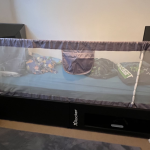
A 12-year-old boy requires a specialist padded railing fitted to his bed. At present, he has a ‘gaming’ style bed which he really would like to keep. He requires a padded full-length bed guard which encloses him but also allows him to get out without assistance.
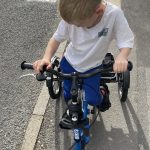
Tricycle steering lock
7th October 2025
A child with cerebral palsy has toppled his tricycle when turning the handlebars too sharply. A bracket was added to restrict the amount that they can be turned.
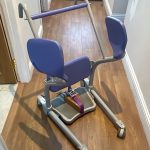
Foot guide for an ARJO Sara Stedy sit-to-stand-aid
24th September 2025
The client uses a standing aid to mobilise from sitting, but one-sided weakness means one foot drags, leading to his standing with poor posture. A guide was added to the footplate to guide the foot into the preferred position.
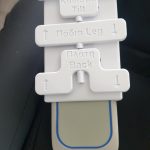
Motorised chair controller
17th June 2025
A client with MS was not able to operate the membrane switches on the controller for his motorised chair. A cover was made for the controller with larger buttons that could be operated with the fist, rather than with fingers.
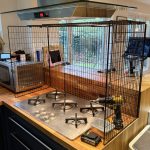
Kitchen stove guard
17th February 2025
The parents of a child with autism need to prevent her from leaning over the kitchen counter and touching the hot stove. A three-sided guard was added.
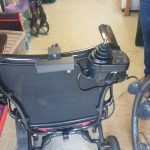
Pedestrian control for electric wheelchair
30th January 2025
The client has a powerchair which he can mostly control himself, however he is unable control it confidently in tight spaces. A bracket was added to the rear push bar so that the controler can be easily moved to be operated by a carer.
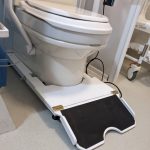
Toilet footrest
2nd January 2025
A client with MS has a toilet that has been raised to assist transfers, meaning her feet are unsupported. Because she has to spend long periods on the toilet, this is painful and a movable footrest was required. Her reduced strength means this must be motorised. A hinged flap was made, lifted by an airbag and battery-powered tyre pump.
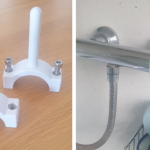
Shower control lever
10th December 2024
The client, who has Parkinson’s disease, found the controls on his shower difficult to operate. The controls were cylindrical and smooth, meaning that there was little for him to grip. A simple lever was clamped onto the control, making it much easier to operate.
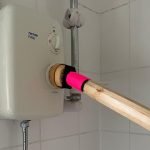
Long-reach shower controller
22nd November 2024
The client needs to be seated when showering and, because of the configuration of the shower cubicle, is too far from the shower controls to reach them. A simple arm engages with the control knob and allows it to be turned.
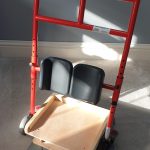
Raise ReTurn sit-to-stand aid footplate
29th October 2024
The footplate of a ReTurn sit-to-stand aid was too low for a child so a simple wooded platform was made to achieve the required height.
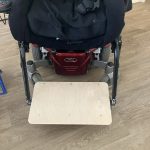
One-piece wheelchair footrest
29th October 2024
The client found that her feet slipped between her wheelchair footrests. A simple plywood platform was made that rested on the existing footrests, holding her feet in place.

One-handed knitting
26th June 2024
This client wanted an aid to allow her to continue knitting after losing the use of her left arm as a result of a stroke.

Food Preparation Device for Amputee
25th March 2024
Our client lost both hands in an accident and wishes to be able to prepare food. A sleeve was made that straps onto his arm to which different knives can be fitted.

Adapt sit-to-stand aid
16th October 2023
A 9-year-old child had difficulty supporting herself when transferring using her ReTurn sit-to-stand aid. A padded knee divider supports her legs and guides added to the footplate locate her feet.

Supportive pony saddle
14th September 2023
Please note that this solution was developed in collaboration with the horse’s owner, who is also an occupational therapist. It is provided as an example of previous support and may not be feasible to offer in the future.
The client requires a frame to support her while pony riding to improve her posture and core strength. The adjustable frame clamps onto a standard saddle and provides sufficient support while also encouraging exercise to strengthen her muscles.

Buggy safety tether
7th May 2023
The client is concerned that she will release her baby’s buggy during an epileptic seizure and requires a means to restrain it.

Table place setting template
27th March 2023
The college student has no fine muscle control and often will spasm when trying to use his hands. Laying the table for banquet service is part of the curriculum and currently the student is unable to participate.

Changing mat restraint
27th March 2023
The client is very active when being changed and their carer requires a means of providing gentle restraint.

Changing mat guard rail
27th March 2023
The client uses a changing mat that fits over their bath. The mat folds up out of the way during bathing. This active child has learnt how to roll off the mat very quickly. The bath manufacturer makes a guard rail that fits into sockets on the mat. Unfortunately it must be removed by lifting in order to fold the mat so as to use the bath. Due to its weight and length it requires two hand and is quite large to store without the risk of it falling and hitting someone or thing. A rail is required that remains in place when the mat is folded away and can be opened/closed one-handed.

Buggy rain canopy
29th December 2022
The manufacturer of the client’s new buggy does not offer a rain canopy, and the canopy from the previous buggy does not fit.

Wheelchair leg and arm supports
28th December 2022
After a stroke, the client’s left side weakness means he needs his wheelchair to be adapted to provide additional support to his left arm and something to restrain his left leg to maintain proper posture.

Changing bed steps
9th December 2022
The school required steps to enable a small child with good mobility to climb up onto a changing bed with the minimum of assistance. It is hoped that he will gain confidence and be increasingly able to mount the bed as he grows and develops. Currently two wooden steps are used, assisted by two carers to climb up to and down from the bed.
A two-step, easily-cleanable, single unit with removable & height adjustable handles on both sides (removable depending on the child – to allow the legs to be swung to the side.) was requested. The aim being that the child holds onto the handle whilst climbing up and, if capable, swings their legs onto the bed. To come down, the child would hold the handle in his right hand, sit on the edge of the bed and slip off onto the top step and progress down to the bottom step and floor with the aid of the handrail. It is expected that the handrail height doesn’t need to be adjusted whilst in use.

Tilting bed
8th December 2022
The client requires her daughter’s profiling bed to be kept flat when the head end is raised while she is continuously enterally fed over a 12 hour period. Keeping her head higher than her feet will enable her to be fed safely to avoid aspiration. This is a standard feature on many such beds, but not this one.

Braille Swing Cell
14th October 2022
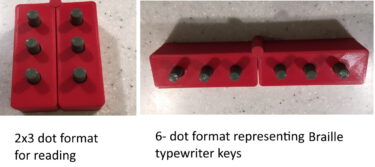
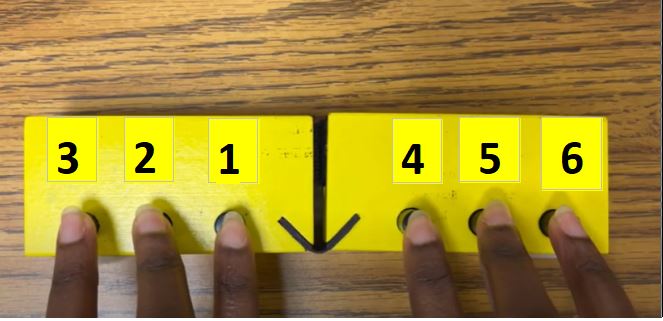
Braille is read using a 6 dot pattern arranged as two columns of 3 dots to define each letter. When it is typed, the six keys of a Braille typewriter are arranged in a straight line left to right (ie. in a linear 6 dot format) which are each pressed by three fingers of each hand. Students therefore need to be able to recognise the patterns in both formats.