Child’s voice amplifier
25th January 2019

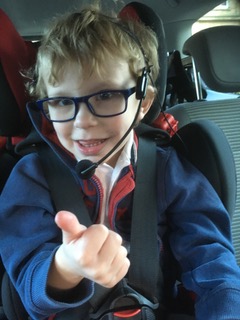
James using his amplifier
James is 4 years old and has vocal chord palsy which means that he can only speak with a very quiet voice, due to a paralysed vocal chord. It is less of a problem at home, but when there is any background noise, it is extremely difficult to hear him, particularly at school and when out and about in his wheelchair and the car.

Wheelchair tray
23rd January 2019

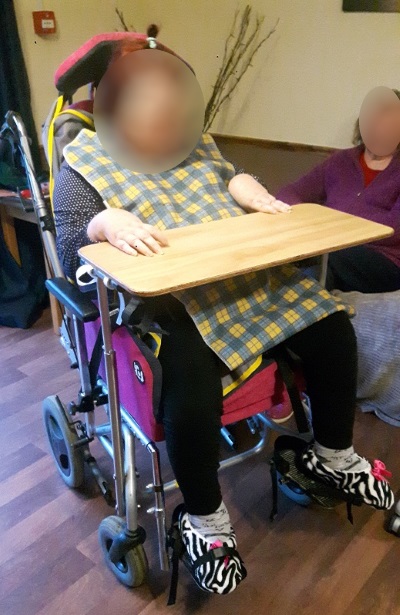
Wheelchair tray in use
The current wheel chair tray is too big and heavy to take outdoors. The client requires a bespoke lightweight version which can be stored on the wheelchair when out and about.

Adjustable wheelchair controller bracket
16th January 2019
 Client with short arms requires an adjustable bracket for the controller of her wheelchair to make it easier to reach and to move out of the way when not needed.

Tandem buggy
14th January 2019
Client has a disabled child in a disabled buggy and a new born baby in a standard buggy. She wishes to have some means to take them out together.

Wheeled garden tool holder
14th January 2019

Wheeled trolley
A gardening charity needed a means for a volunteer with severe back pain to carry documents and small gardening tools etc around the gardening site.

Bed controller access control
14th January 2019
Client is 18 years old with learning difficulties and uses a profiling bed with a wired controller. His carers need a method to prevent him from misusing the controller.

Book stands
14th January 2019
A special needs school required book stands for its pupils, but found that those from the preferred school supplier too expensive.

Reading stand
14th January 2019
A child with spina bifida also has difficulties with eye sight and neck pain and he struggles to look down at what he is reading. He finds it much more comfortable to look directly in front of him. He requires a stand for his tablet and his books.
Audible target for blind child
7th January 2019

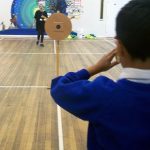
Throwing ball at sound target
A blind child requires a target that he can practice throwing a ball at, to develop his ability to identify the direction and distance of sounds in everyday life.
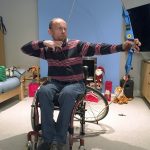
Jack for wheelchair archer
2nd January 2019
A wheel chair user wishes to return to archery. To avoid the bow clashing with one of the wheelchair wheels, he removes one wheel and supports the chair on a jack. A change of wheelchair means the jack no longer fits his chair.
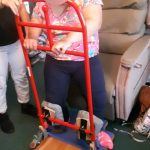
Modify sit-to-stand aid
24th December 2018

Modified ReTurn7400 sit-to-stand aid in use
The client’s feet are splayed and this means she cannot position herself far enough forward to safely stand on the platform of her ReTurn7400 sit-to-stand aid.
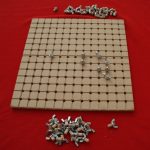
Blind Go board
24th December 2018
A blind person wished to play the ancient Chinese game of Go.
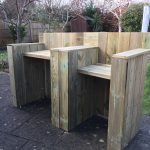
Mud kitchen
24th December 2018
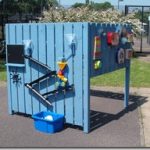
The special needs school required an outdoor mud kitchen for children in wheelchairs to play.
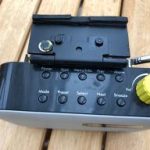
Radio push-button controls
11th December 2018
The client’s advancing dementia made it difficult to operate the baffling array of buttons on his new DAB radio.

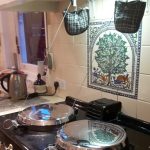
Aga stove lid lifter
8th December 2018
The client’s osteoporosis and consequent bent back, shorter stature and damaged spine made it difficult to reach and lift the heavy lids on her Aga kitchen stove.
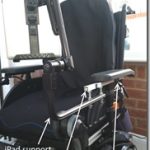
Modify iPad support bracket to fit wheelchair
30th October 2018
 The client had purchased an iPad support bracket to attach to his motorised wheelchair, but this was made of round section aluminium and not compatible with the smaller, square tube mounting bracket provided under the wheel chair’s arm.
In addition, trial positioning the support bracket with the client in his chair demonstrated that the iPad support bracket had to be mounted substantially in front of, and below this square tube bracket for comfortable use.
The solution employed was to make an adapter from 16mm square hollow section aluminium tube, machined half way along down to 15.5mm square so that it would fit into the existing wheelchair bracket. This was bolted to the iPad bracket with M8 studding, nuts and washers.
The whole assembly can be quickly removed by loosening the wheelchair mount nut and sliding the unit forward if the client wants to travel outside the house in the chair.


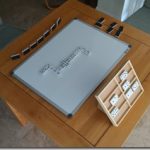
Blind dominoes playing boards
30th October 2018
 A ten year old boy who has been totally blind since birth had recently become interested in playing dominoes. The school had acquired two special sets of tactile dominoes, double six and double nine, where the pips were substantially raised so that blind people could gauge the number of pips by touch only.
In addition to the normal dominoes game, he also wanted to play a variant called Concentration. This game is similar to the game of pairs that children play with picture cards where they try to remember the position of the cards in order to find matching pairs.
In the dominoes Concentration game, the dominoes are placed face down and turned over by each player, as in the pairs game, but this time the “pair” is any pair of dominoes where the total number of pips adds up to 12, e.g. the double six and the double blank are a pair. At the end of the go, the dominoes are again turned face down and the next player must remember both the position and the value. When a pair is turned up, that player removes those two dominoes from the board. The winner at the end of the game is the player who has collected most pairs. This game is much more difficult than the picture cards game. Concentration with the double nine set where the pips have to total 18 is fiendish.
 The problem was that in both games, the boy had to feel the dominoes to get the values. In doing so, he invariably changed their position, making both the standard game and Concentration impossible.
To solve the problem for the standard game, a section of self-adhesive magnetic strip was attached to the underside of each domino. A standard magnetic white board was then used as the playing surface. The dominoes stuck to the white board and did not move when the boy felt them, but where easily removed at the end of the game. A “scrabble” type stand was made so that he could store his “hand” without other sighted players being able to see.
For the Concentration game, two playing boards with grids of cells were made to hold the dominoes loosely in a fixed position. The dominoes could be turned over, felt and turned back over without losing their position. For the double six set, the board had 7 x 4 (28) cells and for the double nine 9 x 6 (54) cells.
Internal ramp
30th October 2018
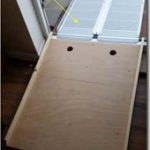
The client required an internal ramp such that she could be wheeled by a carer from floor level up to the patio door threshold onto the commercial off-the-shelf (COTS) aluminium suitcase ramp for access outside.
A lightweight 12mm plywood ramp was made with 3x supporting rails underneath, profiled to rest on the door step, with 4x thin non-slip rubber feet protecting the wooden floor.
The ramp is long enough to give a 1:10 gradient and wide enough to sit either side of the suitcase ramp. There are 2x side rails to keep the wheel chair on the ramp and these are extended to the patio door groove with location pegs to prevent movement once fitted. There are 2x finger holes, so it can be lowered down without finger entrapment.


Wheeled body rollers
30th October 2018
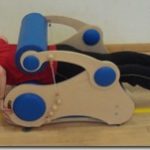
 The special school has two types of body roller to provide deep pressure therapy as the children crawl between the rollers; both have no means of moving them safely.
On the first type of body roller, wheels were added to one end, with brakes scavenged from a condemned wheelchair, and a dolly made to lift the other end to allow the whole to be moved.
On the second type, wheels were added to one end in such a way that they were off the ground in normal use and supported the roller off the ground when being moved (similar to the domestic wheelie bin).