Berkshire - Page 5 of 10 - REMAP

Latest News and Info

Alarm to notify parents when teenager is leaving the home

Robert Monk of the Berkshire panel is asking for help with the following please.


We have been asked to help the parents of 16 yr old with Downs Syndrome and autism who needs 24 hr supervision. He has the habit of leaving the house on his own and his parents want some way of knowing when he is leaving home.
I have suggested 2 options:

1 – A perimeter alarm system like a burglar alarm or shop door warning with sensors on each external door.  https://www.which.co.uk/reviews/burglar-alarms-and-home-security/article/burglar-alarms-and-home-security/burglar-alarms

Pros: Does not need the client to carry a transponder

Cons: Cannot discriminate between client and others, so others will have to remember to suppress the alarm each time they pass the perimeter (father works nights, so returns at odd hours).  Loud and indiscreet, neighbours will know what is happening, unless we use a system that sends a message to a smartphone. Once he has left home, there is no way of tracking him.

2 – A GPS location tracker that advises the parents when the client leaves a pre-defined area by calling their mobile. http://www.dlf-data.org.uk/products.php?groupid=3020&sortname

Pros: Can be used anywhere, at home, visiting friends, in the park, Disneyworld, etc.  Discreet alarm on smartphone.

Cons: parents believe the client will be reluctant to carry a transponder at all times.

Any better ideas would be appreciated.

Robert Monk

Berkshire Panel

Berks.CaseOfficer@remapgroups.org.uk
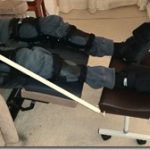
 

Modify foot rest of riser/recliner chair

pic 2 for report
Footstool with added hooks and handle.
Because of his height, the client finds that the footrest of his riser/recliner chair does not support his feet. The footrest cannot be extended, as was done in this solution.

The problem was initially considered as a modification of the footrest by adding a permanent hinged extension to the chair in order to support the client’s feet. However, the proposed solutions either required greater dexterity than the client possessed or interfered with other mobility aids such as his Molift Raiser. It was therefore decided to modify a standard wheeled footstool. Hooks were added around the cushion base, 2x long lightweight handles with hooks were made and a loop of cord was attached. The client therefore has several options as to how he can move the footstool in and out of position himself.


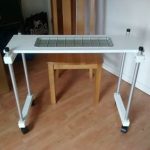
Over-chair table

clip_image002 The client eats seated in her recliner chair and requires a special over-chair table that accommodates her sitting position which in effect raises her stomach up. Standard tables have been found not to work.

A table was made to exactly fit the dimensions of the client’s chair (not that in the picture) with a cut-out into which a narrow Ikea tray fits snugly. The tray is designed to hold sweets and snacks and can be lifted out and washed.


Berks.CaseOfficer@remapgroups.org.uk
Communication aid harness

in use

in use 2
mount
Aluminium mount with detent pin

Tom’s speech therapists were keen that he should have his Communicator with him at all times. The normal arrangement of a shoulder strap meant that he could swing the device, which while he enjoyed doing it, it hardly facilitated its use, and was distracting both to him, his teacher and classmates.

An activity camera chest harness was modified: the elastic waist strap was shortened and the shoulder elastic straps replaced by normal 25mm nylon webbing. The plastic camera mount was replaced by a aluminium backing plate to support the hinge mechanism with a 90 degree movement and removable detent pin.

A Velcro strap retains the Communicator in its folded up position when not in use.

A bespoke mount was created to hold the Communicator utilising the integral strap mounting bars. With the detent pin removed, the Communicator can be detached and used independently. The functionality of the flip out stand is retained.

Finally a pocket was added to the harness to hold Tom’s ever present model train.


Berks.CaseOfficer@remapgroups.org.uk

Buggy mounting steps

IMG_7184
Buggy with steps in position
4 Transit position Transit wheels in use
Several of the children at a special school arrive in  MacLaren buggies which are quite high and they are unable to climb in and out of them. Because of their height and the fact that the seat is angled back, the children struggle to reach the buggy footplate. To encourage them to be as independent as possible, a set of portable steps is required.

After experimenting with a prototype, these attractively painted steps with adjustable height handrails were made. A pair of wheels enable the steps to be easily moved.


Berks.CaseOfficer@remapgroups.org.uk

Stairgates

DSCF7549
Rails at top of stairs …
DSCF7548

… and with board in place
DSCF7552
Bottom of stairs
A mother of three autistic children requires robust gates at the top and bottom of her stairs to prevent falls. Standard stairgates for toddlers are not high or strong enough.

A pair of rails have been fitted at both the top and bottom of the stairs. A simple plywood board is located in one of the pairs of rails as required. There are no hinges or catches; it relies on the friction in the slides to prevent unauthorised use.


Modify ReTurn sit-to-stand aid for child

In use
Platform configured to provide lower height
Raised
Platform in raised configuration
parts
Platform disassembled
return7500
ReTurn in normal use for comparison
The ReTurn aid is used both for transfer of children from a sitting position, but also as a physio aid to stretch their ligaments and improve posture. The users come in all sizes, with corresponding differences in their support wheelchair and school chairs.

The requirement was to provide an adjustable height modification to the ReTurn aid, including heel support to help promote a flat footed posture.

On trials, it was determined that only two different heights would be required. A nesting set of two block platforms was developed, attached to the ReTurn platform via a cross hatched Velcro scheme to allow fore, aft, and lateral adjustments without the need to ensure the male and female strips where aligned on top of one another.

In the stacked configuration, dowels force correct location, and two over-centre clamps ensure rigidity.

The back plate is removable, both to allow ease of use, but also to accommodate the 180 degree placement of the upper platform when stacked.

Two eyehole brackets and clamps provided to allow the standard restraint strap to located higher when the block platform was in use.


Adjust height and stabilise commode

IMG_0950 Small The standard commodes available are of the wrong height for the client’s toilet bowl and, because she favours one side when getting up, tip over sideways. The tiled floor and under-floor heating mean that the commode cannot be bolted down.

The wheels were removed from an otherwise suitable standard commode and feet added. The feet were bolted to aluminium plates to increase the sideways stability.


Berkshire Panel Job BK2018/13.

Berks.CaseOfficer@remapgroups.org.uk

Handles for wheeled garden seat

DSCF7541 The client struggles to get up from a wheeled garden seat when gardening. The handles on the seat are too low and the seat moves sideways when getting up.

A pair of free-standing handles provide the required height and their bases act a brakes on the seat.


Handrail for riser armchair

in place
New rail
side view
Side view
bracket Rail
and feet
stabilising foot
One of two feet added
To suit the changing condition of the client, the arm rest used during the client’s transition from wheelchair to armchair (made under job BK2017/42C) was modified.  The electric raiser chair was too unstable for the new rail to be fixed, as the locking castors still allowed the chair to move under load.

Two additional feet were added to the steel base frame and a new rail fixed.


Trombone playing support

IMG_2684 Padded dish …
IMG_2685 … mounted on client’s stand.
A trombone player requires a support to take the weight of his instrument to allow him to continue playing after a stroke.

A simple padded dish (a repurposed dog feeding bowl) was fitted to the client’s trombone stand with a length of threaded rod (to give height adjustment).


Wheelchair support handles

WC foot supports raised Wheelchair with foot rests raised …

WC foot supports down
… and foot rests down in normal use.Ladder bar
The client was struggling to carry out standing transfers from wheelchair to toilet, particularly when out and about.

“Ladder bars” handles were bolted onto the underside of the wheelchair’s existing footrests, and a new plate fitted to allow the footrests to be rotated and locked into an upright position, presenting the handles for use.

The handles can be left in place, hidden below the foot rests, when the wheelchair is in normal use, so no extra paraphernalia needs to be carried.

The height of the handles will rise in the future as the foot rests are lowered to accommodate leg growth.

The modifications are easily unbolted when wheelchair is returned.

The client’s mother was chuffed to bits with the way that they can also be used as restraints when the client is sat on a normal toilet, to prevent him falling sideways, and in disabled toilets where the usual fold-down arms are far too wide apart for him.

Raise sofa

underside
Feet fixed to underside of sofa
support
Detail of clamps used to fix feet to framesofa raised
Completed raised sofa with valance
The client required his reclining sofa raising by 3” without interfering with the mechanism. Some loose wooden blocks had been provided, but they were unstable.

Four wooden feet were made which clamped to the base frame of the sofa. A valance was included to prevent the client’s feet from getting trapped underneath.

Headrest for dining chair

pic2
Head rest fitted to dining chair, wheelchair behind
pic3
Brackets with paper template
pic4 Brackets fitted to chair back
The client uses a wheelchair with a headrest to support her head, but wishes to use a standard dining chair while eating. A headrest is required to prevent potential choking.

The solution agreed was to add a bracket to the dining chair to allow the wheelchair headrest to be easily fitted when required.


Special wheelchair ramp

current position
Current situation
IMG_2668
Two-piece light weight ramp installed
IMG_2667
The ramp
The client’s carer is unable to move the client on his wheelchair from his bathroom down two steps into his bedroom. The ramp supplied is too steep for his carer to push the wheelchair up and a longer one will be too heavy to be moved to enable the bedroom door to be closed.

A light weight two-piece ramp with a non-slip surface was made.


Shaped back support

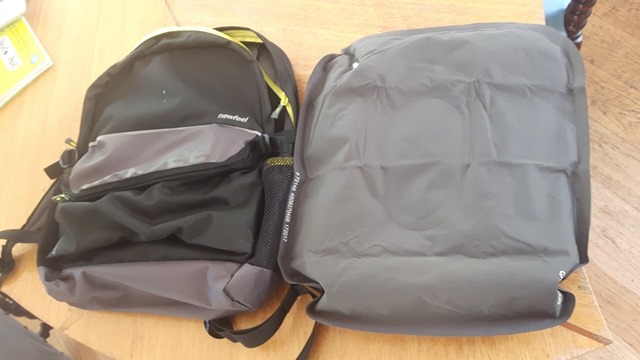
Back pack and half inflated cushion from Decathlon
Back pack and half inflated cushion
Rucksack and shaped foam
Back pack and shaped foam
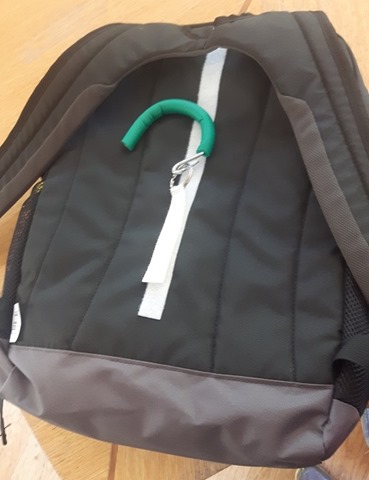
Backpack showing the moveable hook on a velcro strap
Back pack with hook in position
Client sitting against the backpack containing the air cushion
Back pack in use
The client has a protruding shoulder blade as a result of scoliosis which makes it very uncomfortable to sit in most chairs and required a solution that is discrete.

He was supplied with two aids: One was a foam cushion shaped to fit to the actual shape of his back. The second was an air cushion bought from Decathlon. Both are intended to go into a soft back pack which can either be worn or put on the seat between the client and the chair back. A hook which attaches to the back pack with Velcro to provides adjustment to ensure the back pack hangs on the back of the chair at the right height.

In order for the air cushion to mould itself to the client’s back and not to the shape of the chair (which could be too short or could include struts for example), a board was inserted into the backpack to provide a flat surface so that the air cushion would press against this uniform surface.

The advantage of the air cushion over the foam cushion is that it will adapt itself to almost any shape of back and therefore can be worn by anyone with a similar condition and is very quick and cheap to assemble.  A disadvantage is it can feel a bit wobbly. The foam cushion on the other hand requires carving into shape, taking time and skill, and is a bespoke product for that individual.


Raised flower beds for special school

DSCF7516
DSCF7518
A special needs school wanted to encourage their children to enjoy gardening and needed to make it accessible to wheelchair users.

Four plywood flower beds on legs were made.


Stiffen suitcase ramp

 DSCF7465
ramp support 1
Support bracket
ramp support 2 … located in place.
The client has a high rear doorstep requiring a long 7 foot suitcase ramp.  However it was found to bounce disconcertingly in use.

The ideal solution would have been to use the hinge bolts of the ramp to permanently attach legs. The client didn’t want such a solution, so a simple block with captive end brackets was created.


Sacrificial chewing aid

chew straps The client has a compulsion to chew her clothing and needs a replacement sacrificial chew aid.

Two fabric slings were modified with quick release snap connectors like the type that are used on ID badge neck straps. The device can be worn around the neck with low risk as the connectors will release if pulled or if the wearer gets caught in it.


Vomit detector

image The client is unable to reposition herself in bed and is at risk of choking on her own vomit if left unattended.

A detector was made using a water detector mounted on a plate and linked to the nurse call pager system. The system activates when a resistance of just over 4 megaOhm is bridged across the detector wires. The client can now receive the vital care she needs quickly without having to have constant supervision.


Hobby workstation

image004 Drilling the hazel stick

image002 Drilling the antler
IMG_6008
A finished walking stick
The client has suffered a stroke and would like to continue with his hobby of making walking sticks with deer antler handles while seated in his wheelchair and with the use of only one hand.

He requires to drill the irregularly shaped hazel sticks and the even more irregular antlers down the centre. The two parts are then assembled with a 8mm steel screw thread and spacer through the middle which is epoxy glued together.

A jig was made that could be set up in a Workmate by the client’s carer, consisting of two interchangeable tables to hold either the stick or the antler. A drill was mounted on a sliding table.

The stick is mounted on the first table between centres at the correct height using a selection of stepped bushes roughly the size of the stick and then clamped up with the three screws in a chuck motion. The drill is then pushed into the stick and the hole is produced central down its length.

The antler is mounted on the second table made of a Mole grip clamp mounted onto a heavy duty ball and swivel. The clamp can be positioned in any alignment allowing the antler to be drilled along its centreline.


Modified arm of riser armchair

Chair armrest
Existing arm rest
chair grabrail in position
New grab rail in position

chair grabrail New grab rail
The armrest of riser armchair was used heavily during the client’s transition from wheelchair to armchair. He didn’t use the elevate function, but preferred to use his upper body strength to transition. His concern that the armrest lacked a good purchase.

The armrest was easily removed, and a handle and fixing bracket designed to fit snugly over the side panel. Clamp screws were added, but these were not required upon fitting. The bracket was made of recycled marine ply from a kitchen and a hardwood tent pole.

This job was subsequently modified under BK2017/80.


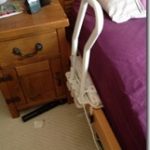
Rotating bed grab handle

existing bed grab handle
Existing arrangement
New bedrail
New rotating grab handle
The existing commercial bed grab handle did not allow the client to maintain a firm grip as he maneuvered out of bed into his wheelchair.

The new handle clamps to the side rail of the bed and allows limited rotation to ensure the client has a firm grip as he rotates out of the bed.  It was made from re-purposed parts.


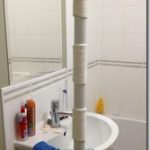
Improved grip for vertical grab poles

polegrips The client found that his wet hands slipped on the floor-to-ceiling poles in his bathroom.

Both poles were fitted with paracord whipping over double sided carpet tape to provide a secure hold.


Motability Registered with the Fundraising Regulator Lottery Community Fund Logo
Website by Agency For Good

Copyright 2026. All Rights Reserved