

Novel Head Support
Our client suffers from MND and experiences head drop when sitting upright which is, among other things, causing difficulties with using assistive technologies. This simple solution of using a fixed hat solved the problem.
The Challenge
Our client suffers from MND and experiences head drop when sitting upright in his chair or on his bed He has a trachea fitted which precludes the use of a collar or any device that fastens under the chin. The head drop is, amongst other things, causing difficulties with be able to use assistive technologies.
The solution
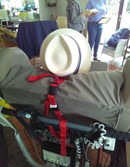
Captive Hat provides support to minimise Head drop

York volunteer Dave Chartres devised a novel solution which was to fasten one of the many hats which the client has to a narrow luggage strap fastened over the back of his chair and also the same with his bed. The strap was placed under the hat-band which was sufficient to hold the hat securely.
The benefit
Our client was able to get sufficient support to hold his head and was able to communicate more easily and begin to use assistive technologies. He also got to wear one of his favourite hats in bed!
- Skills involved:
- Issues Addressed:
- Activities Helped:
- Location:
- Solution:


My wife Caterina has very similar problems particularly in bed where the carer has to hold her head for her to be able to use the eye gaze. She is in a hospital bed which needs to be able to be moved up and down, particularly if she coughs. Did you manage to get an OT to approve this
solution? Any help or advice or contact would be very much appreciated as we are pretty desperate.
Hi Christopher, I’m not sure if an OT was involved in this particular case, but we have made similar solutions for people with the same challenge that were approved by OTs. If you think Caterina could benefit from a custom solution, then please do complete our referral form. All our equipment is provided free of charge and we’re always keen to help where we can: https://remap.org.uk/referral-form/
This simple solution solved the problems that others (including myself and many healthcare professionals) assessed as complexed. The outcome was that my lovely husband was able to use eye gaze to communicate his wishes and more importantly chat to others. Being able to communicate his wishes and feelings were so important in the last weeks of his life and enabled him to have an input into his palitive care plan.