Berkshire - Page 6 of 10 - REMAP

Latest News and Info

Fall protection for epileptic

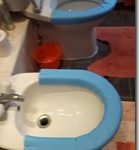
 3.3 Padding fitted to toilet and bidet
Toilet and bidet
1.3 Mat showing additional strip of padding between the top and the blue edging using offcuts, to cater for raised lip of ceramic sink, and to ensure water drains back into the sink and not onto the user.
Kitchen sink
2.1 Offcut of mat used as desk protection
Desk
The client’s mother required protection around the home against drop seizures of her epileptic child.

For the toilet and bidet, closed cell foam protective edge strip (sold for packing of paintings and mirrors) were used. It is designed to absorb knocks, is waterproof and washable. By cutting pieces out of its edge, it was made to conform the the shape of the bowls.  Additional pieces were supplied for when the others are being cleaned.

The sink area is protected by a shaped pad cut from a thick closed cell physiotherapy exercise mat, designed specially to absorb impact. This is also waterproof and washable. It is colour-coordinated to match the kitchen. Holes in the left hand section allow water to drain through onto the draining board below.

An off-cut of the mat was used to protect the desk.

Additional protection was provided for use at school, see below.

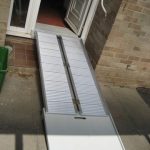
Extend suitcase ramp

IMG_2641
Before

IMG_2646
After
The client had difficulty manoeuvring his manual wheelchair through the front door because the ramp supplied is too steep.

An extension to the outside ramp and an indoor wedge ramp were added.


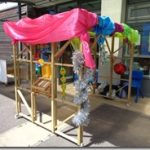
Activity stand

Frame in use
Frame2
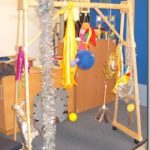
A special needs school required a mobile outdoor stand onto which various items could be hung to provide visual and tactile stimulation to the children.

A simple free-standing pergola-like frame on castors was made.

Similar indoor frames have also been made.


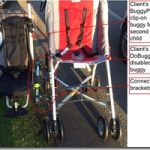
Tandem disabled buggy

combined buggies2
both bkts2
The client uses a DoBuggy disabled buggy for her elder child and wishes have the means to take her younger child out with her.

The client bought a BuggyPod clip-on buggy which is designed to clip on the side of most buggies with universal quick-release connecting brackets.  However, because of the design of the disabled buggy, the standard brackets did not allow it to fold up.

Additional brackets were made to allow the BuggyPod to be connected and disconnected easily using its standard brackets, and the DoBuggy to be folded as usual.


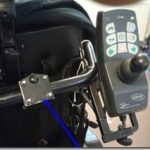
Move wheelchair controller

Existing arrgt Existing location of controller …
Reqd arrgt  … and required location.
Bracket New carrier plate and re-used clamping bracket
New bkt installed The new arrangement
The client’s pedestrian-controlled motorised wheelchair was awkward to manoeuvre in restricted spaces because the rear-mounted controller protruded too far and there was insufficient adjustment in its mounting bracket.

A new carrier plate was made to fit the existing clamping bracket. The new location is much more convenient.


Activity stand

Gantry in use gantry A special needs school required two mobile indoor stands onto which various items could be hung to provide visual and tactile stimulation to the children.

Two simple A-frame gantries on castors were made.

A similar outdoor stand has also been made.


Modified Derby half-steps

Steps

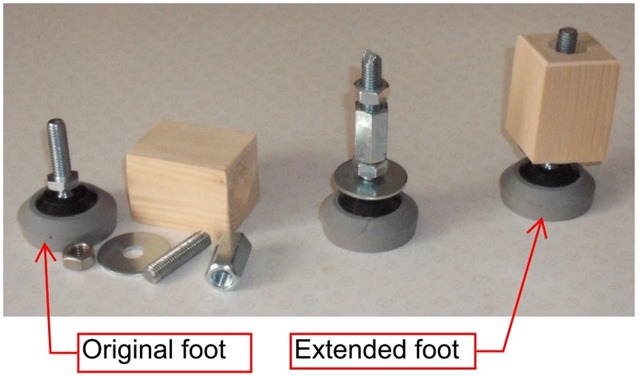
Extended foot

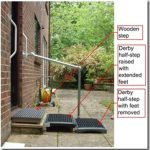
The client struggles to raise her feet when walking and so was unable to navigate her doorstep to leave the house.  The standard Derby half-steps are too deep to sit on the existing doorstep and are also too high for her limited ability to raise her feet.

A wooden step was made to fit the existing doorstep and two half-steps modified to create in effect a 2/3 step and a 1/3 step.

The client can now leave her house.


Door entry control panel

the problem
The problem
Finished solution
The solution
levers
Levers and top hinge bracket
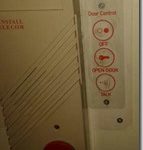
The client had difficulty operating the buttons of his door entry control panel because they were mounted too high to reach and the management company was unwilling to lower the panel.

The door control touch pad consisted of 3 vertical buttons; only the lower two buttons are used to talk via the intercom and to unlock the door. The client needed the action lowered by ~15cm.

Levers were fabricated from slats of hardwood; finger-sized push-buttons and key pads were turned from boxwood. The two brackets were made from convenient aluminium sections. The hinge-pin is an M6 coach bolt.


Laptop charging plug

Unmodified plug  The problem …
bracket and plug
  … and the solution.
bracket The bracket
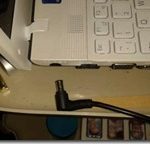
The client has arthritis and finds it hard to manipulate the plug of the charging lead into the matching socket of her laptop.

A simple bracket was made from 3mm aluminium, to which the charger lead was secured with cable ties.  It was bent slightly so that it did not foul the edge of her work-table tray.

A similar problem and solution: iPad tablet charging plug handle.


Wheelchair bag

bag in use
bag closed
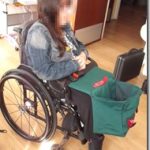
The client required a bag to hold her shopping while using her wheelchair, but was no longer able to reach behind her to a bag hung on the seatback.

The bag was made to sit in front within easy reach with a strap that supports it from the arm rests.  Integral padding protects the thighs and calves from pressure.


Modify car steering wheel spinner

Spinner-4
Modified spinner fitted to steering wheelspinner before
Unmodified spinner showing opening …
spinner closed
… and now closed up
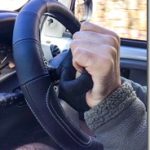
The client wished to replace the spinner that he uses to control his car steering wheel, but the replacement model had an opening in its handle which made it hard to use.

A metal closure was fitted and the whole padded with bicycle handlebar tape.


Outdoor ramp

platform in use
Platform in use
platform in place
Platform in place
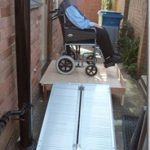
The client is unable to exit the back door of his house with his wheelchair because the restricted space on his side path precludes the use of standard ramps.

A raised platform, level with the doorstep, allows a standard suitcase ramp to be used.


Bicycle handlebar adaptation for prosthetic hand

Bike in use Handle
Prosthetic hand on handle
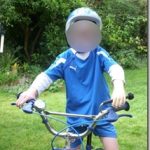
A young child with a prosthetic hand struggled to hold the handlebars of his bicycle.

This simple aid clamps onto the handlebars and allows the hand to grip.


Modified sit-to-stand aid

Completed job

DSCF7407
Knee separator
DSCF7406
Foot rest

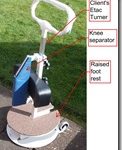
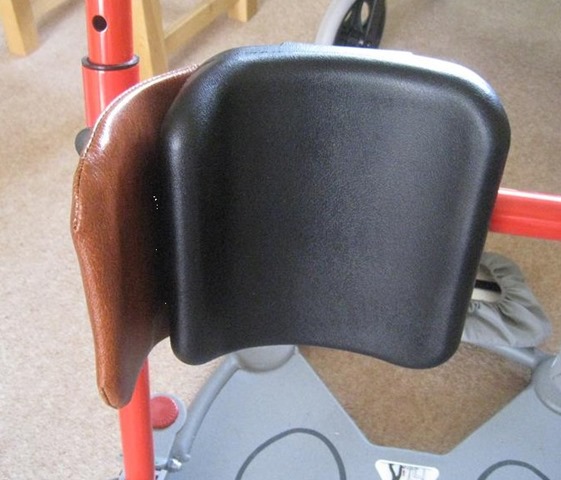
The client required her Etac Turner sit-to-stand aid to be modified to include a padded panel to separate her knees and a raised foot rest to suit her stature.


Shoe fitting aid

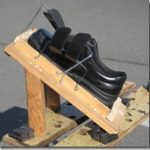
IMG_2615 After a stroke, the client struggles to put on his shoes one-handed, in particular keeping the tongue and Velcro straps open as he slips his foot in.

A sloping stand holds the shoe steady and stiff wire brackets hold the straps open.


Wheelchair tray

WC with table
Table mounted on wheelchair
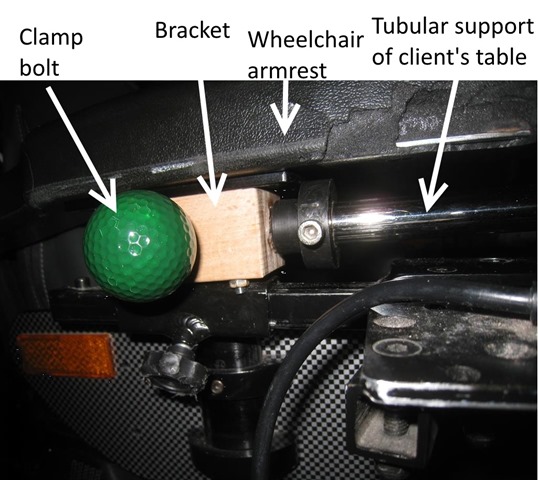
Bracket Starboard mounting bracket
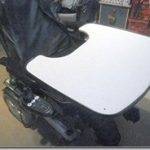
The client requires a table for his motorised wheelchair, but none is available from its manufacturer.

The client’s OT had several unused tables available.  One was chosen, and brackets made and fitted to the chair’s arms.

The clamp bolts were colour-coded port and starboard.


Attach buggy to wheelchair

Connecting rods in use
Brackets connect the wheelchair and buggybuggy clamps
Clamps to connect to buggy
connector rods Brackets with quick-release clamps for wheelchair

Connecting rods connected Brackets attached in relaxed position

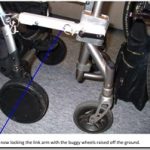
The client requires a means to push her child’s buggy while using her own self-propelled wheelchair.  No permanent brackets can be attached to the wheelchair, but the brackets need to be rigid enough to partially support the weight of the buggy.  When linked to the wheelchair, the rear wheels of the buggy need to be lifted clear of the ground so that the buggy rides on its front castering wheels, for manoeuvrability. Due to the client’s limited lifting ability, some sort of jacking mechanism needs to be incorporated in the brackets, to raise the rear buggy wheels ~2cm clear of the ground.

Two brackets were made that clamp onto either side of the buggy and wheelchair, connecting the two together.

Two clamps (used in yachting to fit canopies) were modified with resin inserts to suit the buggy’s oval section tubes.

The clamps on the wheelchair are easily removable, but firm enough to support part of the buggy’s weight.

To attach the buggy, the brackets are attached in the relaxed position. The levers are depressed to raise the rear of the buggy and pins inserted


Wide child gate

Retractable child gate
Client’s child gate
Gate installed
Gate installed
Unmodified retractor mechanism
Unmodified  retractor mechanism …
Modified retractor mechanism
… and after modification.
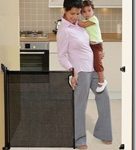
The client is a wheelchair user and needs a child gate to separate the kitchen and dining areas. The opening is wider than the widest commercially available gate.

The client purchased a spring-loaded 1.4m wide retractable child gate and wall extension pieces were fitted to make to opening narrower.

After fitting, the client found it difficult to close the gate against the tension of the rewind spring and to keep the tension clutch disengaged with the twist-and-push release knob.

A hole was drilled in the outer casing of the mechanism for a pin to be inserted to hold the knob in the twisted and depressed position.  Once the gate is closed, the pin is simply withdrawn to activate the tensioning mechanism.


Monorail doorway closure

topdoors closed New upper doors closed …
topdoors open

… and open.
door pole
Pole to open and close the upper doors

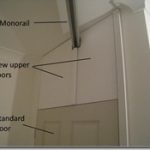
Client has a monorail running from the bedroom to the bathroom which means that the bedroom door does not close. The client is a noisy sleeper and this disturbs the rest of the family.

Two doors were added above the standard door to close the opening.  Because the rail passed through the doorway at an angle, the new doors had to open in opposite directions.


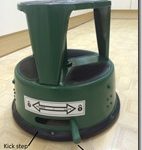
Braked seat/step for kitchen

IMG_0894
Kick step
IMG_0879
Underside showing operating mechanism
IMG_0905
Gliding around the kitchen
IMG_0907
In use as a kickstep
Client only has the upper section of both her arms and is very adept with her two split hook prosthesis. There are times however when she finds it easier to manipulate items with her feet while seated. For this, she requires a low wheeled seat.  She also uses a kick step (as used in libraries etc.)  to reach higher items in her kitchen cupboards. This has spring-loaded castors that raise the step sufficiently to allow it to be moved by the user’s foot, but which allows the step to sink down onto the floor when stood on, for stability).  Because of the limited space available, the seat and step should be the same item.

A kick step was modified so that, by operating a lever, the castors could be locked in the down position (for use as a wheeled seat to glide around the kitchen) or be free to move up and down (for use as a standard kick step).

At the client’s request, it was painted a rather natty BRG.


Foot stop for sit-to-stand aid

Supports in use
Completed job

Knee support Knee support
ReTurn7400
The unmodified ReTurn aid
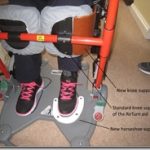
The client has a ReTurn standing aid. After a stroke, her left leg has little function so when using the aid, her foot is prone to slip sideways off the platform and her knee also needs extra lateral support. She also sometimes wears a leg brace.

To locate her foot, a horseshoe shaped piece of plywood was made to fit around the front of her foot. The size and shape was made suitable to fit her foot either wearing normal shoes or the leg brace. The ‘horseshoe’ was screwed to the platform.

A curved metal plate was made to extend the lateral support given by the standard knee pad, secured using the existing bracket.


One-handed sewing

DSCF7353

DSCF7347

Client was very keen on sewing and tapestry but, as a result of a stroke, she can no longer use her left hand/arm.

A pair of plywood boards was made to allow the item to be sewn to be held steady with plastic spring clips. Cunningly shaped holes allowed the needle to be passed through the cloth. The boards can be rotated to present a different shaped hole for different jobs. They can be used together to darn a sleeve. The arrangement clamps to the client’s table.


Handrail

img465
img466
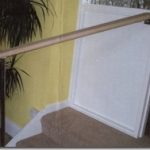
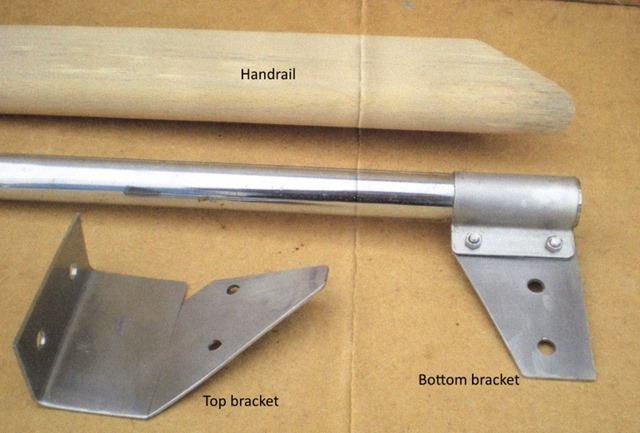
The client required an indoor stair handrail in an awkward location, and the suggested Magic Rail was unsuitable.

A bespoke angled rail was made and fitted.


Reduce width of 3-wheeled walker

pic3
Original over-centre locking linkage with frame in closed position …
pic4 … and locked in open position.
pic1 New fixed linkage
pic5
Spacer added
pic2 The finished narrower rollator
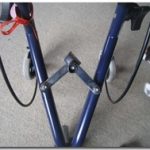
The client’s 3-wheeled folding rollator was too wide to pass easily through the doorways in her home and she found the over-centre linkage that locks the rollator in the open position too stiff to use.  Unless the opening linkage is fully locked, the frame can (and has) closed up.

As the frame closes, the rear wheels ‘toe out’, so the amount that the frame could be closed to make it narrower was dictated by what was an acceptable amount of ‘toe out’. The reduction in width that could be achieved while retaining acceptable wheel alignment was approximately 60mm.

At this opening, the existing linkage would not lock so a new, fixed linkage was made to replace the existing one. It was secured on studs with butterfly nuts so that it was still possible to fold the frame, (for transport, for example).

The hole centres on the fixed linkage were 10mm less than on the original linkage (in its locked position). This reduced the gap between the vertical section of the frame (carrying the handles) so that the basket would not quite fit as normal. (The hooks on the basket fitted over the thumb screws that lock the handles in place.)  Spacers were inserted on the threads of the thumbscrews to compensate.

All the changes to the walker are easily reversible to its original state.


Motability Registered with the Fundraising Regulator Lottery Community Fund Logo
Website by Agency For Good

Copyright 2026. All Rights Reserved