Skip to main content
Latest News and Info
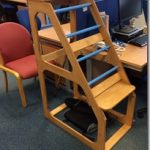
Standing aid
5th February 2016
 |
The client’s spinal problem made it difficult to get up from a sitting position at his desk.
A ladder-type stand was made that allows him to pull himself up. For stability, it is bolted to the desk. The client is very happy with it and thinks it looks like a piece of Ercol furniture. The space below the stand has been found useful by his colleagues to store their personal items!
|
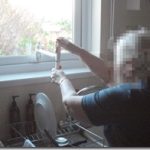
Window opener
31st December 2015


|
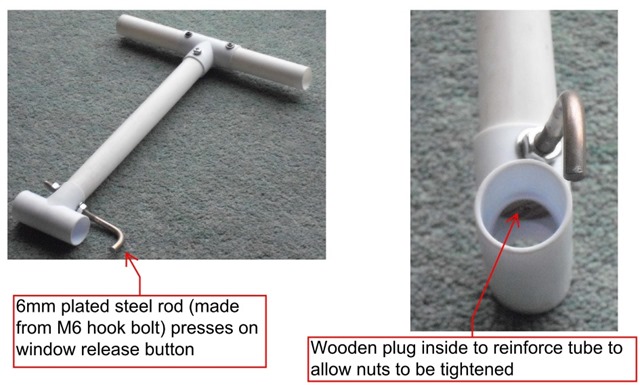
The client struggles to open the uPVC windows of her flat because her condition does not allow her to depress the release button and turn the handle easily.
The tool is made from 22mm plastic tube and two Tee pieces. One Tee is passed over the window handle. The steel finger presses the release button on the window catch, allowing the handle to be turned. |
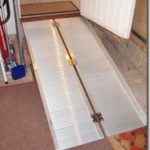
Wheelchair ramp
21st December 2015

|
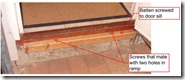
The client wishes to have wheelchair access from a utility room down two steps into the garage. The supplied briefcase ramp was too wide to fit in the door opening and would not allow the door to be closed with the ramp in position.
A 40 x 40 x 700 wooden batten was screwed to the wooden door sill, on which the upper end of the ramp rests. Two screws mate with two over-size holes in the ramp to stop it slipping when in use but still allow it to be lifted out when needed.
|
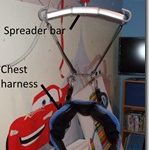
Modified lifting harness
21st December 2015


|
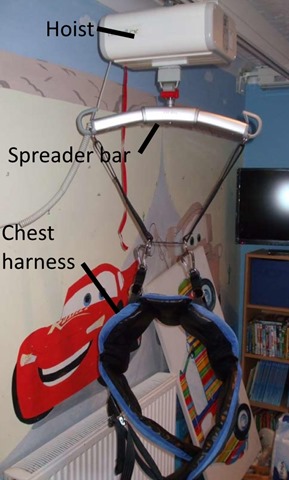
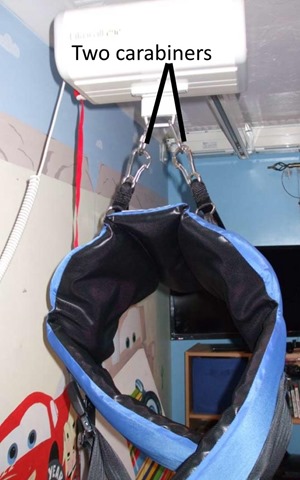
The client uses a monorail hoist but, because of his height and the low ceiling, the hoist cannot lift him high enough. The spreader bar was removed and replaced by two climber’s carabiners to connect the chest harness directly to the hoist, gaining 300mm.
The hoist can now be used correctly.
|
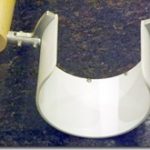
Sock aid
19th December 2015
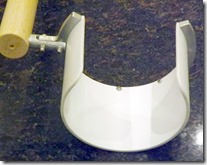 |
The client struggles generally with dressing, in particular putting on his socks, because he is unable to bend to any degree due to his condition. The dressing aid supplied by social services required too much bending. A commercial aid that would have suited (and similar in design to the one actually made) had poor reviews in regards to its robustness.
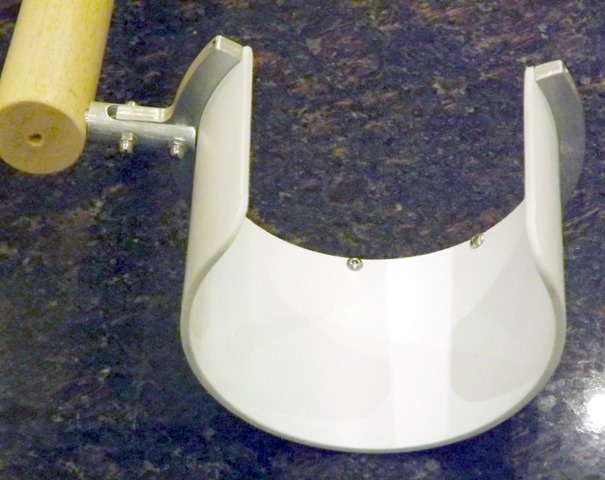
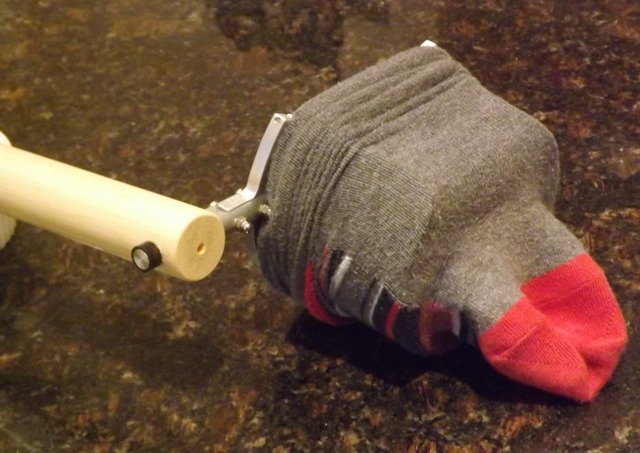
The device is made from a horse-shoe shaped metal ring, a length of 110mm diameter plastic waste pipe and a length of wooden dowel. The ring and pipe assembly is attached to the dowel by a pin which allows it to pivot. The dowel is approximately 1m long and can be held over the foot while the client is sitting, without any need to bend. |
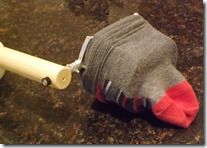 |
The sock is slid onto the plastic pipe with the heel at the bottom and only the toe section protruding. |
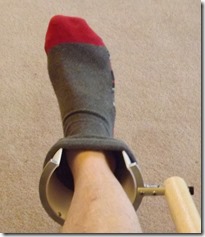 |
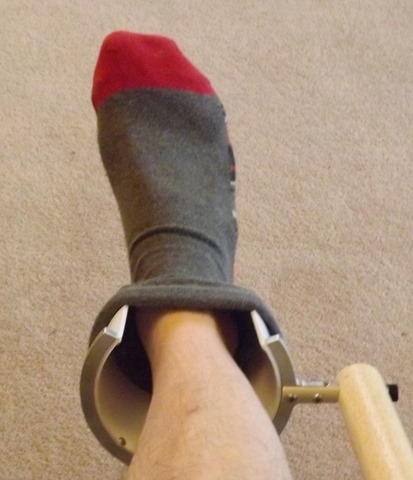
The sock holder is slid along the foot, over the heel and part way up the calf before being pulled out of the way behind the leg.
The client is now able to put on his socks unaided. |
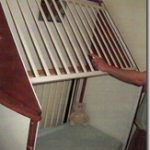
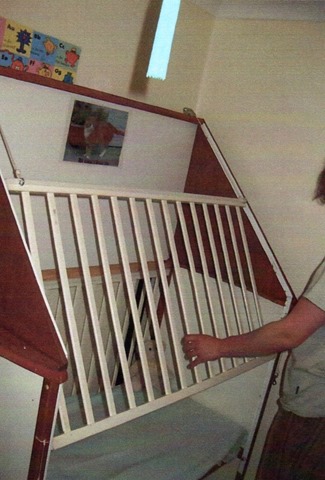
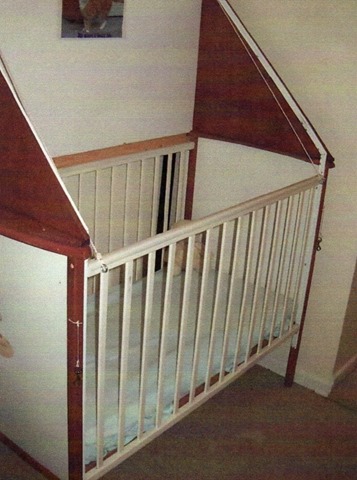
Moveable cot sides
10th December 2015
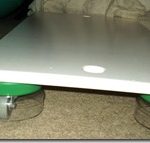
Scooter board
10th December 2015
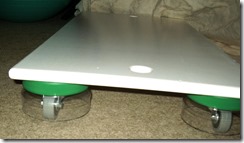 Scooter board Scooter board

Guard around casters to deter little fingers |
An autistic child needs a scooter board to aid sensory development of a size larger than commercially available ones.
The board was fitted with a clear plastic cup, cut to a suitable length, around each caster to act as a guard.
|
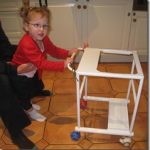
Trolley walking frame
10th December 2015
 |
A child with Downs Syndrome cannot walk unaided. At his Montessori school, he need to be able to select his own activity from where it is stored and take it to his table.
He requires a trolley to provide him with support and a means to carry the activity.
The trolley is sized to suit the activities of different sizes and the height matches his desk to make transfer easier. The trolley has four castors, with the rear ones able to be locked inline if necessary. The lower members of the frame are made from heavy wall pipe to ensure a low centre of gravity.
|
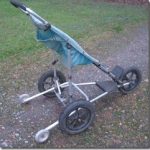
Off-road rollator
8th December 2015

Off-road rollator
 Showing rear outriggers Showing rear outriggers |
The client uses a standard rollator to getting about on paved areas, but needs something similar for use on soft ground.
A large-wheeled tricycle type buggy was modified with the addition of rear outriggers made from the wheeled part of a Zimmer frame.
|
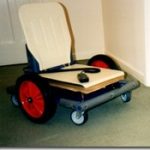
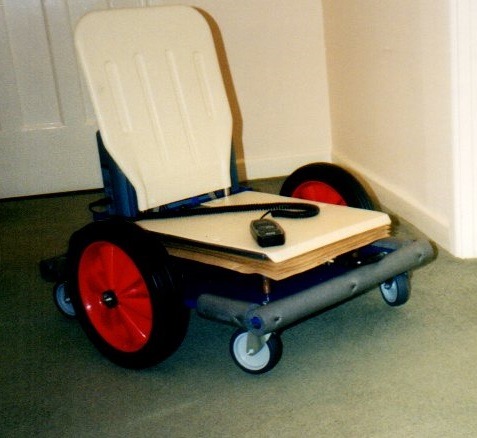
Mobile Mangar Booster Seat
23rd November 2015
 Completed seat, lowered, showing the seat remote control. Completed seat, lowered, showing the seat remote control.

Completed seat, raised, showing the air pump and battery pack
Trolley, without foam bumpers |
The client uses a Mangar Booster Seat to get on the floor (eg. to play with her child) and then get up again. The seat is inflated with a battery powered air pump. She required a means to make the seat mobile.
A simple trolley was made. The two larger 300mm wheels allow it to be moved by the user, as for a hand powered wheelchair. The air pump and battery pack are retained in the box with a Velcro strap.
|
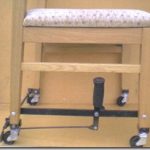
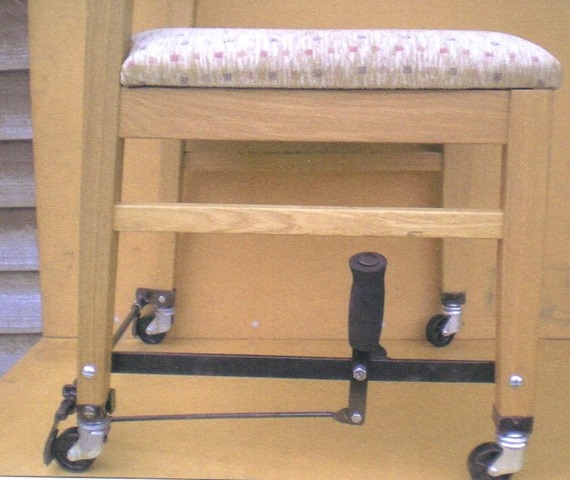
Chair with castors
23rd November 2015
 Chair with castors braked Chair with castors braked
 Chair with castors unbraked Chair with castors unbraked
 Sketch Sketch
|
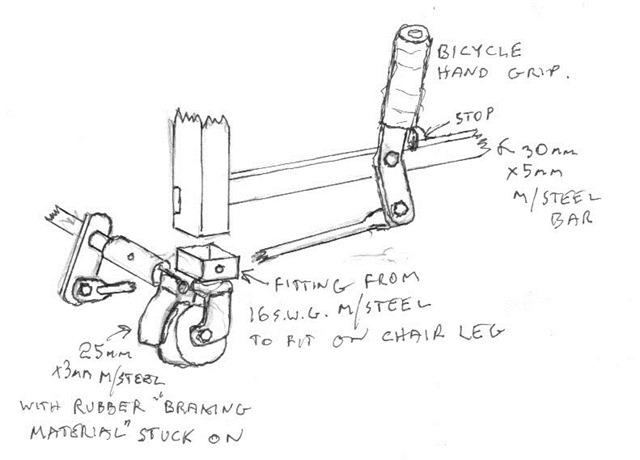
The client needs to be able to move his dining chair easily under the table to eat, etc.
Castors were added to the chair with hand-operated brakes on the trailing castors.
|
Bathing support cushion attachment straps
6th November 2015
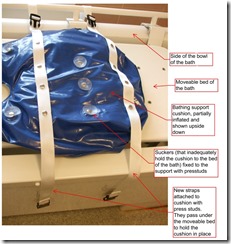
Straps, cushion and bath

Straps, showing press studs |
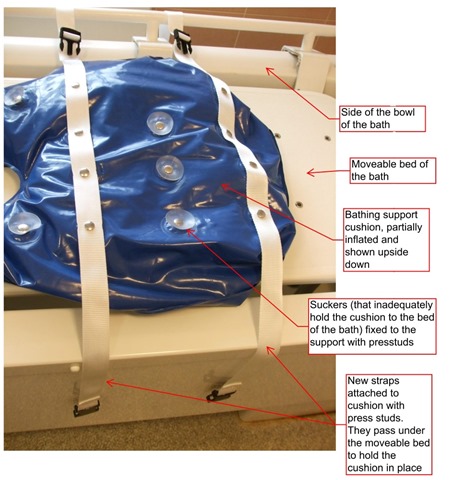
A care home has a bath with a moveable base within the bowl of the bath that is used to raise and lower the user into the water. An inflatable shaped cushion is used to support the user. The cushion is attached to the base with suckers but, because of the surface finish of the base, they do not attach securely enough and the cushion floats out of position.
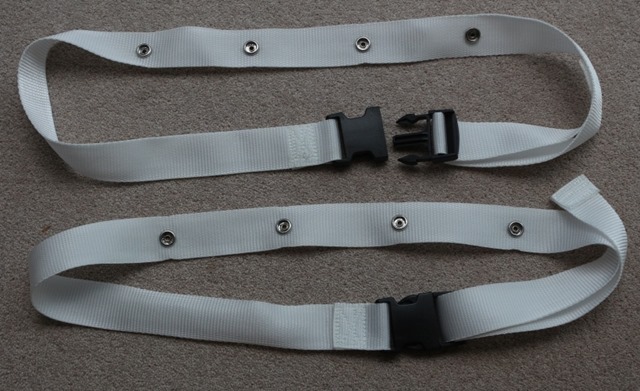
It was decided to attach straps to the underside of the cushion which would then pass under the bed and close with plastic buckles. The suckers are attached to the cushion with press studs and it was found that they could be removed and those same press studs used to attach the straps.
The cushion stays in place but can still be easily removed when required.
|
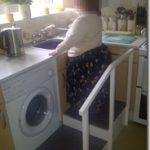
Raised kitchen platform
21st October 2015

Platform in use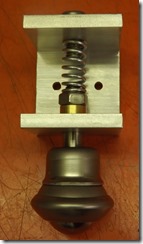
Spring-loaded castor and support bracket |
The client, who is 4ft 2in, uses boxes to allow her to stand at the kitchen sink to do the washing up and look out over her garden. This was unstable and she had already fallen once. A stepped platform 25cm high with a hand rail was made. It is easily moveable so that she and other members of the family can gain access to the cupboards and drawers, and also secure when in use. A set of four spring loaded ball castors were fitted with springs chosen to lift the weight of the platform when unloaded, but to retract as soon as the client stepped on (similar to a kick-step used in libraries).
|
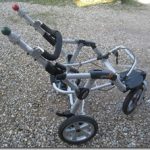
Off-road rollator
21st October 2015
Finished rollator

Un-modified buggy frame |
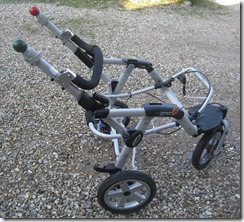
The 6-year-old client is able to walk short distances indoors, but when outdoors, she needs an aid which is manoeuvrable but gives her stability and some protection against bumping into things and able to cope with moving over rough ground. It will help to improve her stamina, balance skills & confidence and to join her family when they are out and about. A child-size off-road rollator is not available to buy.
The family had an off-road buggy which was no longer required. This was modified to lower the handle bar and move the rear wheels further forward to reduce the overall length and improve stability. The over-long vertical tubes were not cut down to allow the changes to be reversible. It still folds for storage and transport.
|
Wheelchair bull bars
26th August 2015

Guard in use
The parts used |
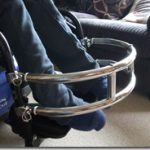
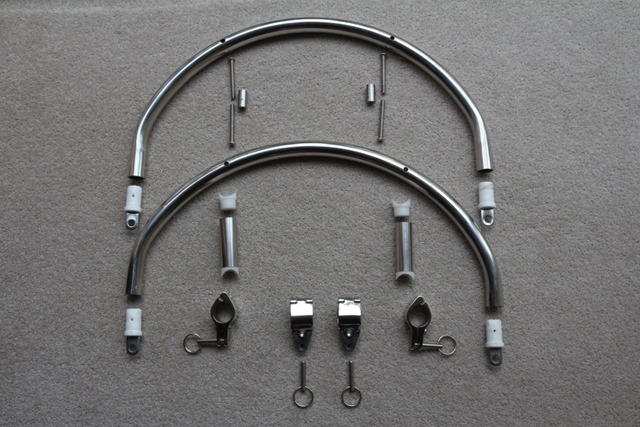
The client is particularly vulnerable to fractures to his ankles and so used to place his feet behind his wheelchair footrests to protect them from collision, which caused discomfort and pressure behind his knees.
The stainless steel tubular guard provides the necessary protection to give him the confidence to keep his feet on the footplates. Quick-release clamps (used on boats for attaching canopies) allow the guard to be removed without tools when needed.
These bull bars were subsequently modified to fit the client’s new wheelchair. |
Dressing stick
30th July 2015

|
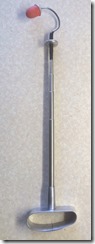
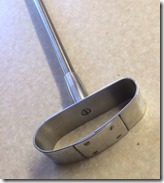
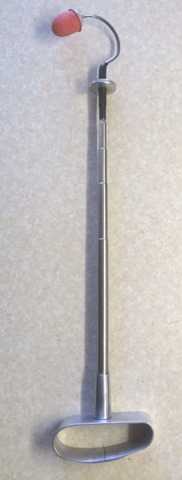
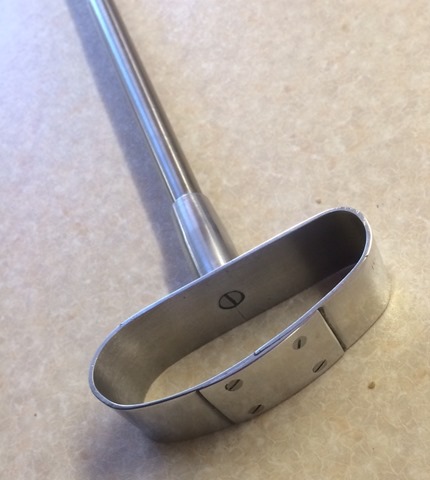
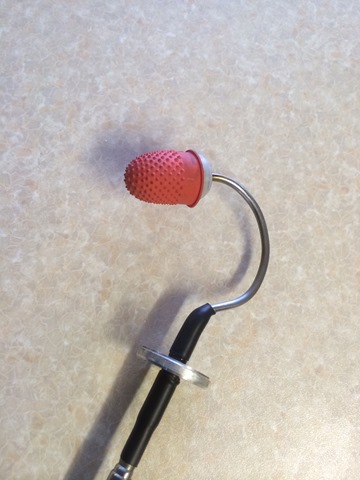
The client required a telescopic dressing stick with a handle suitable for her reduced hand gripping ability.
The stainless steel telescopic shaft of an inspection tool formed the main body. An aluminium handle was formed to match the
shape of the client’s hand, joined by a small cover plate. A turned aluminium boss was attached to the handle and this was push fit glued to the telescopic body. A coat hanger and rubber thimble formed the hook.
|
iPad tablet charging plug handle
30th July 2015


Original metal version

Later 3D printed version …

… and USB memory stick
|
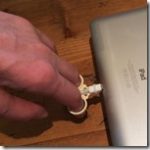
The client’s limited dexterity means that she cannot plug and unplug the charger of her tablet.
A bracket was made from two brass rings soldered to a small brass plate and attached to the charging plug with cable ties. The client no longer relies on others to recharge her tablet.
This aid was subsequently replaced with a similar one made in ABS plastic by 3D printing with matching holder for a USB memory stick.
A similar problem and different solution: Laptop charging plug
|

Knife adaptation for split-hook prosthesis
28th July 2015

Knife in use
Knife tang with pins added

Knife and prosthesis
|
The client finds it difficult to safely hold a kitchen knife with her split-hook prosthesis.
The plastic handle of the client’s knife was removed and the blade drilled to accept two small stainless steel pins welded in place. The pins were located such that the hooks locate around them and the end of the knife tang locates into the hinge part of the hook under the elastic bands.
This proved so successful, the client asked for other knives to be modified in a similar way.
  
|
OT exercise stand
18th July 2015

Stand in position

Underside |
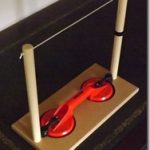
A special needs school required a miniature “washing line” to enable students to practice pegging items on the line as an OT exercise.
The solution consisted of a wooden base with two upright posts 400mm apart. Holes in the posts allowed the line to be set at 300 or 360mm above the desktop. The free end of the line was secured to one of the posts with a Velcro strap. A low-cost commercial suction pad was used to hold the device firmly in place, the desktop being very smooth.
|
Modified bath transfer bench
3rd June 2015
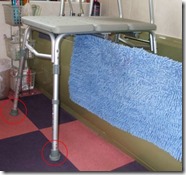
Bench with extension pieces fitted

Extension pieces with boxwood dowel inserts, grooved to ensure free drainage.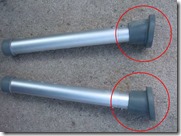
Legs with extension pieces fitted, retained with SS screws. |
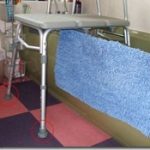
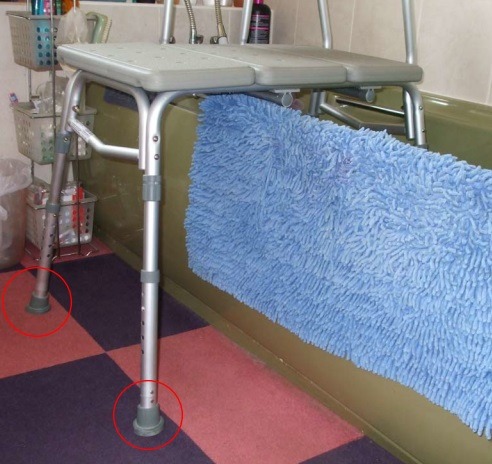
The client’s bath transfer bench has adjustable legs to cope with the difference in height between the bath and floor, but this is insufficient for the client’s bath.
The two outboard legs were extended to resolve this, re-using the original rubber feet. The modification is fully reversible.
|
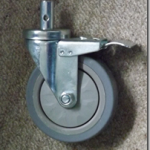
Reduce height of commodes
21st May 2015
 Original wheel Original wheel
![clip_image002[4]](https://remap.org.uk/wp-content/uploads/2023/05/clip_image0024_thumb.png "clip_image002[4]")
New wheel as delivered![clip_image002[6]](https://remap.org.uk/wp-content/uploads/2023/05/clip_image0026_thumb.png "clip_image002[6]")
New wheels as modified
![clip_image002[8]](https://remap.org.uk/wp-content/uploads/2023/05/clip_image0028_thumb.png "clip_image002[8]")
New wheels fitted |
The client had been supplied with two commodes but, being only 4ft 9inches, she found the seats too high to use.
The commodes were fitted with large wheels so the seat heights could easily be lowered by installing smaller wheels. New wheels were purchased and modified to make the fitting method identical to the original. The seat heights were thus reduced from 49.5cm to 42cm.
A secondary concern was that the potty could only be removed from behind the chair which the user found inconvenient. The chair back was moved to the front and the arms repositioned and secured with cable ties to effectively reverse the chair and allow the potty to be removed from the front.
|
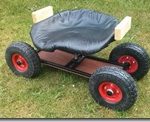
Wheeled garden seat for amputee
19th May 2015

Finished seat

Forming the seat cushion

Underside of seat showing screw height adjustment and plywood board tool tray |
The client is an amputee and requires a wheeled seat to allow her to continue with her gardening. The seat cushion needs to be custom shaped to suit the asymmetric amputation and have arms to help her to sit down and stand up.
The shape of the client’s bottom was taken using a bean bag made of a bin liner full of polystyrene beans. The form of the beanbag was held by drawing a vacuum with an airbed pump while a plaster of paris mould was made. A GRP seat was made and covered with foam padding and leatherette.

Seat in use |
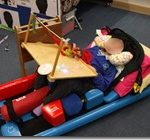
Activity stand for prone child
11th May 2015

Activity stand in use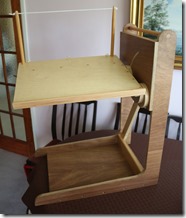
Activity stand
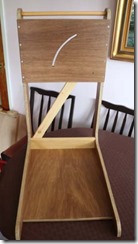 Frame Frame |
A severely disabled child needs an adjustable stand to hold her toys so she can play with them while lying prone.
First thoughts of modifying a commercial over-bed table were dismissed after it proved difficult to source anything suitable. The tray is tilt adjustable, and includes screw-in eyelets and a string “washing line” to tether her toys. The height of the feet is a tight fit under the bed, which makes it very stable and secure.

Tray underside

Tray top |
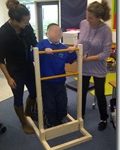
Standing frame
31st January 2015
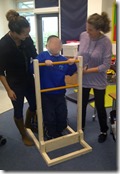
Standing frame in use

Frame folded |
The client is unable to stand on his own and spends most of his time either in a wheelchair or on a low stool while at school.
A simple folding frame was provided with two rails at different heights. The lower rail allows him to pull himself into a standing position and the upper one allows him to maintain it. The frame can be folded for storage or transport.
Its use was so successful, the client’s mother asked for a second unit for use at home.
|
Copyright 2026. All Rights Reserved















![clip_image002[4]](https://www.remap.org.uk/wp-content/uploads/makeabilityimagearchive/2015/05/clip_image0024.png "clip_image002[4]")
![clip_image002[6]](https://www.remap.org.uk/wp-content/uploads/makeabilityimagearchive/2015/05/clip_image0026.png "clip_image002[6]")
![clip_image002[8]](https://www.remap.org.uk/wp-content/uploads/makeabilityimagearchive/2015/05/clip_image0028.png "clip_image002[8]")