Berkshire - Page 9 of 10 - REMAP

Latest News and Info

Drum stands

Bongo_3
Drum and stand in use
Bongo_1
Stand dismantled
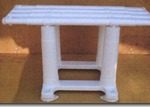
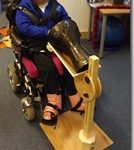
The school has a number of bongo drums which serve as instruments that the pupils can use and enjoy. The problem is that bongo drums are designed to stand on the floor with the user sitting forward and over the drum. This is not possible for a person sitting in a wheelchair, especially when upper body movement is restricted.

The solution was to construct a stand in two parts, a base and an upright which included the drum holder. The upright fits into a socket on the base and is held in place by two toggle clamps. The drum holder is in the form of a bricklayer’s hod which can hold drums of the various sizes owned by the school. The hod is attached to the upright by two adjustable, hand tightened, clamps which allow both height and angle to be set to suit each user.

The stand can be broken down, both for storage and for carriage when visiting other locations.  The plywood base allows the wheelchair wheels to ride over it without damage.  Three stands were made.


Raise piano

DSCF1441
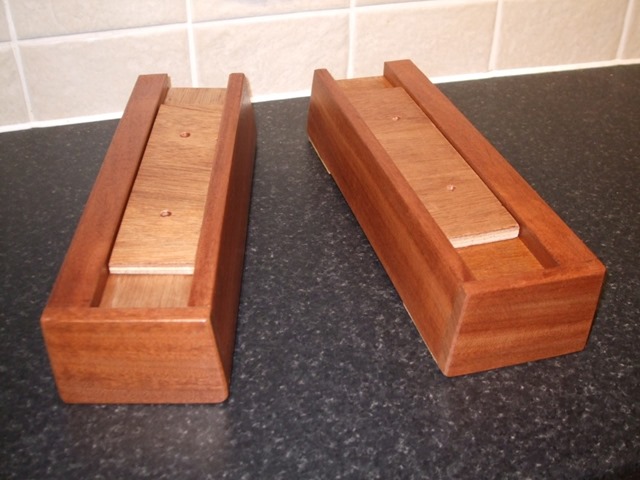
Blocks to raise piano
 DSCF1445
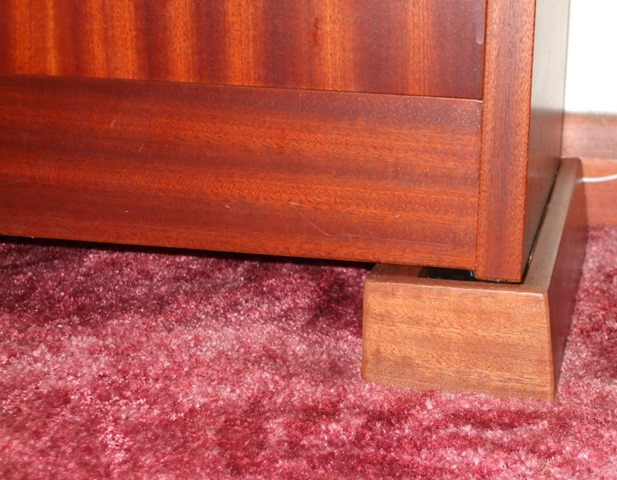
Blocks in place
 IMG_1237
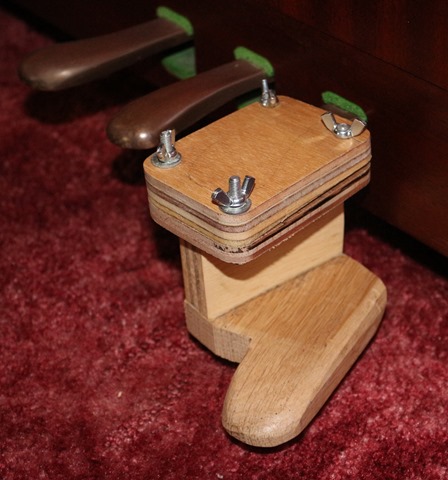
Sustain pedal bracket
The client required his upright piano to be raised so that he can play while seated in his wheelchair.  The sustain pedal must remain at the original height.

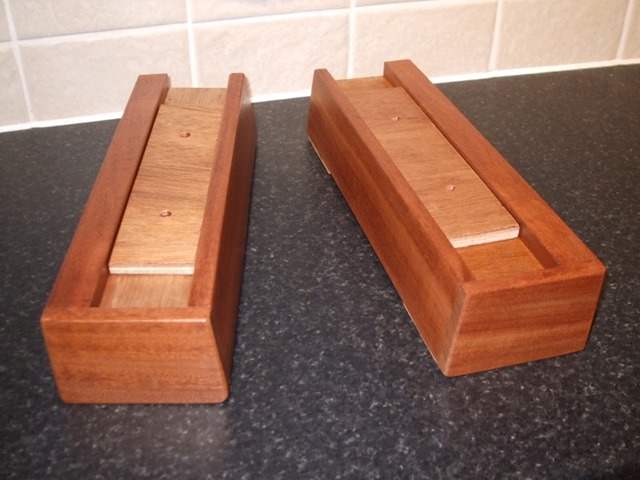
50mm high blocks were made from layers of plywood and faced with mahogany to match the piano.

A plywood bracket was clamped to the pedal to lower its action to near floor level. Because the upper surface of the pedal was curved, the lower surface of the top half of the bracket was hollowed out.  To ensure it conformed exactly to the complex shape of the pedal, the cavity was part-filled with epoxy filler, the pedal covered in cling-film and the bracket bolted in place while it set.  Once set, the excess epoxy and film were removed. The assembly then clamped firmly to the pedal.


Toy tether

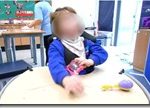
Chair tray with toy tethers
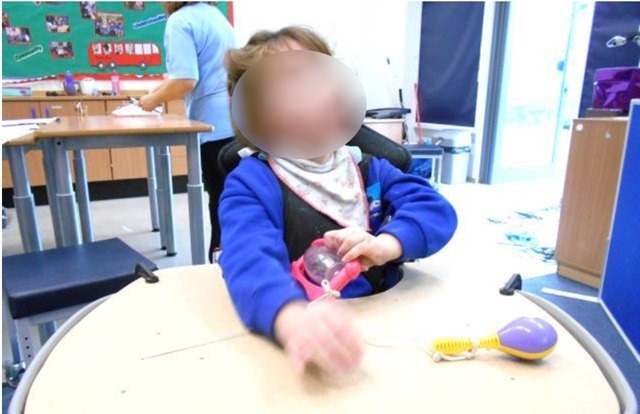
Client playing with her toys
DSCF6821
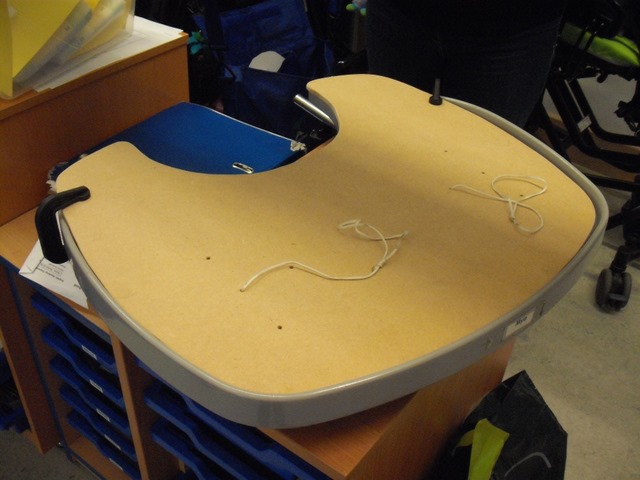
MDF sheet with tethers.


The client is a young girl who inadvertently loses her toys from the tray of her chair, which then need to be retrieved by her carers. A sheet of 10mm MDF was shaped to fit neatly inside the fiddle around her chair tray.  The sheet is held firmly in place by two G-cramps, although its weight may prove to be all that is necessary.  A pattern of 3mm holes, countersunk on the underside face of the sheet, are fitted with a selection of 2.5mm cords, each having a running loop on its free end.  Each loop is drawn tight around one toy.

The client can now play without the risk of losing her toys.


A similar project was made using a Perspex sheet insert and suckers on the ends of the cords.


Height Adjustable Table for Exerciser

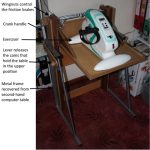
 IMG_1241 Table in upper position
IMG_1240
Table in lower position
The client uses a cycle exerciser for both legs and arms, but is unable to raise it from floor level (for leg exercise) to chest level (for arm exercise) unaided.

A crank-operated rising table was made to raise and lower the exerciser between the two levels.  Two cams hold the table in the upper position.  Fraction brakes control the speed of descent.

More detailed pictures and description are available.


Modified Bathseat

medici bathseat
Unmodified Medici bathseat
garden chair and SS parts
Modified garden seat and SS parts
medici bathseat modified
Final modified Medic seat
The client is hoisted into her bath and requires a seat to support her while she is showered.  The standard bath boards were not suitable for her shape of bath and the Medici seat she was using did not provide the necessary support.

A plastic garden seat was modified and bolted to the Medici seat to provide the necessary support.


Bicycle pedal straps

Pedals in natural positions

Pedal rotated to show fixing method

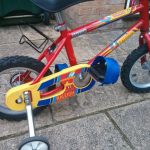
A 4 year old child with spina bifida has difficulty keeping her feet on the pedals of her bicycle.  Commercial pedal clips are only available in adult sizes.

Straps were added to the existing pedals. The metal parts provide counterweights to ensure the pedals naturally sit with the straps upwards.


Urine bottle stand


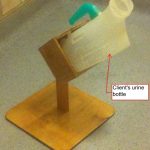
The client is unable to hold his urine bottle to urinate while sitting in his wheelchair due to reduced manual dexterity.

This floor-mounted stand holds the bottle at the required height and angle.  The flat plywood base does not interfere with the wheels of the wheelchair.


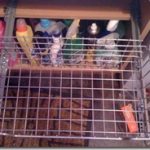
Aerosol actuator

Aerosol with foam cap

… with cap removed and valve stem exposed.
trigger fitted
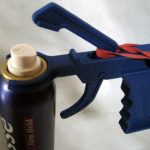
Button spray nozzle and trigger gun fitted. The elastic band (kindly donated by Royal Mail) holds the lever up for ease of use.
The client suffers from rheumatoid arthritis and has great difficulty in using aerosols.

Investigation showed that the aerosols in use had a combined spray  nozzle and cap and this complex shape was the main reason for their being hard to use. If the cap is removed, the valve and valve stem that are exposed are fairly standard and a simple button spray nozzle can be fitted to the valve stem in its place.  This can then be operated by a commercially available spray trigger gun (as sold in car spares shops for spray paint cans) which clips around the crimp seam between the body and the valve.  By having a selection of simple standard spray nozzles and several trigger guns, most aerosols can be adapted by the client to be easily operated.

Understanding the underlying issues and re-purposing a readily available tool were all that was needed to provide an elegantly simple solution. The rubber band was Remap’s only technical innovation.

The client can now operate all his current aerosols and has been provided with the skills to be able to use the new aerosol styles that will be encountered in the future.


Musical instrument trolley


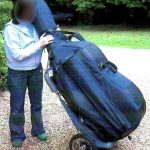
A disabled music student struggled to move her double bass to her classes.  A collapsible trolley was made from re-cycled aluminium crutches.  The neck of the double bass acts as the handle of the trolley when in use.


Wheelchair footrest release

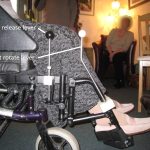
The client is unable to reach down to release her wheelchair footrests to allow them to be rotated out of the way.

Replacement footrests were bought from the manufacturer that use a vertical push release.  The release button has been extended so that it is within reach of the client and a second lever added to allow the client to rotate the footrest.  This is duplicated on both footrests.


Bath tap and plug operators


Bath tap operator
Bath plug operator


Bath plug operator lower end
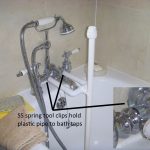
The client is unable to bend sufficiently to operate the taps and plug while sitting in her bath.

A tap operator was made out of 22mm chromed steel pipe with a ring at one end to engage with the lever-operated taps.

The operator for the plug was made from 22mm plastic pipe.  The lower end is fixed to the plug.  The upper end is fixed, via D-shaped piping, to the bath taps with stainless steel clips (normally used for storing tools) which has sufficient flexibility to allow the plug to be opened and closed.


Treadmill side rails


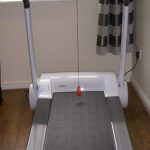
Unmodified treadmill

Side rail

A child needs to exercise on a treadmill but currently, his parents must hold him to provide support and stability.   Side rails have been clamped to the existing treadmill so he can support himself.

Top bracket

Bottom bracket

Catheter bag drip tray

clip_image002 The client was concerned that drips from the catheter bag hung on the side of his bed would stain the carpet.

A small plastic tray was purchased and clipped to the bag support stand with fold-back clips.


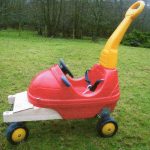
Modified toy car


The car before modification …
 
… and after
A terminally ill child with Cockayne Syndrome wants to be able to play in her own toy car, but her disproportionately long legs means she cannot use a standard one.  A donated Little Tykes car was sourced through Freecycle and modified to increase its height by 90mm and length by 200mm to suit.  A seat belt was added.


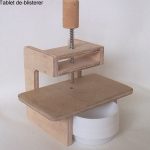
Tablet deblisterer


Other similar designs…

Owing to arthritis, the client is unable to remove his arthritis tablets from their foil blister pack wrapping.  The blister pack is placed onto the platform with one tablet lined up with the plunger.  Pressing the plunger forces the tablet out of its wrapping into the container below.

Other similar designs have been made over the years.

Since these aids were made, the range of commercial aids has improved and something like this may be suitable , even for those with dexterity issues:


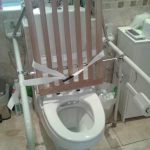
Toileting support

Completed seat back in position.

SS parts and one of the two webbing straps.
Client requires support to maintain an upright position on her toilet at home. The style of the toilet means that the commercial toileting support systems cannot attach in the normal way (using the screws that secure the toilet seat on) because they would interfere with the toilet’s self-cleaning and drying functions.

The slatted seat back is attached to the pre-existing wall-mounted handrails by 22 dia. SS support poles with marine-grade end fittings.  It is easily removed or adjusted with thumbscrews or quick-release pins.  Two webbing restraining straps (only one shown) at chest and waist height hold the client in position.

A head rest can be fitting in the future, if required.

The client can now be toileted in a dignified and safe manner.


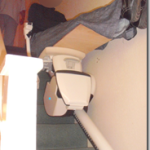
Stairlift leg support


Legs supported by board and client’s own weight

Cord restraint


Board stored when not in use

The client is a wheelchair user and must keep her legs straight. Her wheelchair has leg supports to achieve this, but her stairlift does not, meaning she cannot use it.

A new varnished plywood board rests on the stairlift seat to support the client’s legs while travelling on the stairs, held in place by the client’s weight .  The board’s freedom to movement is restricted by a length of cord that passes behind the seatback.  The board also serves as a transfer board to allow the client to move from wheelchair to stairlift and vice versa. The board can be stored when not in use and does not affect the stairlift in the parked position.


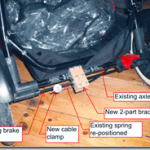
Buggy failsafe brake

Modifications to the buggy wheels


Modifications to the buggy handlebar

New parts

New clamp to fix new brake cable to existing brake rod.  Identical clamp was used to fix the cable at the other end to the new brake bar

The client is concerned that her epilepsy will cause her to lose control of her buggy while out and about and requires a brake that apply automatically.  Such brakes are not available for any buggy.

The existing parking brake engages a rod into the hub of each rear wheel. The rods were originally spring-loaded to retract. For this modification, the spring from one brake rod was removed and fitted such that it forces the rod into engagement with the wheel hub. The other brake rod was not modified and still acts as a parking brake.

A new two-part bracket is clamped to the existing axle and holds the end of the new brake cable sheath, while allowing the existing brake rod to move freely.

A new brake bar is fitted into two holes, one drilled into the inside of each arm of the existing buggy handle. It is made from 6mm dia SS rod bent to shape. The end of the new brake cable is clamped to it. The brake cable sheath is held in a standard bicycle brake part, fixed to the existing buggy handle.

Holding the new brake bar up withdraws the existing brake rod from the existing wheel hub and allows the buggy to move. Releasing the brake bar allows the spring to force the brake rod into engagement with the wheel hub, stopping the buggy.

An alternative approach is wo proved  a tether between the buggy and user: https://www.makeability.org.uk/project/23054/buggy-safety-tether/

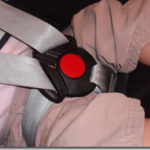
Seat belt buckle release tool

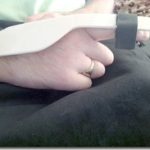
The red button must be depressed to release the belts.


A mother with rheumatoid arthritis is unable to open the buckle of her child’s car seat belt.

A simple G-clamp was made that can be slipped around the buckle.  Turning the screw depresses the red button of the buckle, releasing the belts.


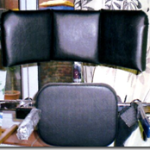
Wheelchair head restraint

The client required a bespoke head restraint to fit her bespoke wheelchair.


Adult stairgate

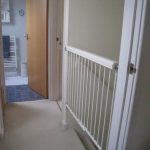
  Client is unsteady on his feet and  is concerned he could fall down the stairs at his home while moving along the landing during the night to visit the bathroom.  Because of the limited space, the gate had to be completely removed during the day.

A gate was made from a metal child’s stairgate, with the plastic hinges and catches replaced by metal ones and a wooden handrail added. Safety catches stop the gate from being removed unintentionally.


Tablet touch screen aid

The client was unable to operate the touch screen of his iPad Tablet because his condition made it impossible to keep his index finger straight.

A shaped finger splint made from 2mm thick ABS is held in place with two Velcro straps.

The client can now use his Tablet.

Car seat protector


Wooden frame to protect the seat rails and fabric fitted under seat base

Finished foot well with ‘new’ carpet


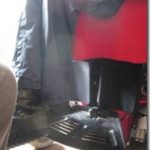
The client is an adult male with learning disabilities who, when sitting on the rear seat of his car pushes his feet under the seat in front and damages his shoes (and occasionally injures his feet) on the metal parts under the seat.

A wooden frame was made to fit in the foot well and a fabric cover (food-grade conveyor belt) fitted under the seat base.

The parts are easily removable when the car lease expires.

The client no longer damages himself or his car

This job was subsequently repeated on a new car under BK2015/08 .

Treadmill handrails

BK2014-09 DSCF6659

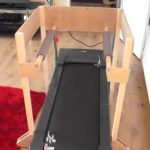
The client is a young boy who is unable to support himself on his legs and uses a Rollator to get about.  As part of his therapy, needs to exercise on a treadmill, for which handrails are required to support him.

This free-standing design requires no modification to the treadmill and allows it to be removed for others to use.  The location of the hand rails can be moved to allow for the client’s future development.

The client can now exercise without assistance.

See alternative solution.


Motability Registered with the Fundraising Regulator Lottery Community Fund Logo
Website by Agency For Good

Copyright 2026. All Rights Reserved