Chair for competitive seated fencing
Our client is a young woman with mobility impairments who enjoys competing in wheelchair fencing. This involves two people either using wheelchairs or possibly one non-disabled person in a fixed ‘training’ chair (see below). The chairs are strapped to a floor frame that sets the distance and angle between the competitors, and they then score points by landing blows onto jackets fitted with electronic sensors. It can get quite violent…

Wheelchair fencing
Our client (on the left) was using a conventional wheelchair fitted with suspension when competing. This involved several problems, including the ‘bounce’ of the suspension, the relative lightness of the wheelchair construction and the absence of a solid grab handle, which is essential to brace the competitor when lunging at the opponent.
Wheelchairs designed for this application cost a minimum of £2500, and although our client could have used a static chair (like the one on the right), they are no longer made.
The conclusion, in discussion with the client and her family, was to look at ways to build a simple static chair that would have the right adjustability and strength to provide an effective platform for her sporting activities.
The Challenge
The intention with the project was to use timber and plywood to make a rigid framework for the chair that would be capable of withstanding the forces created by the sport. This was originally going to be reinforced by some metal parts made using an existing supplier for the grab rail and footrest, but these proved to be expensive:

Initial design
This resulted in a re-design and parts were eventually sourced from commercial suppliers who made steel brackets for the footrest and bathroom support handles that made an ideal grab rail:

Fencing chair – final design
The height of the grab rail, height of the footrest and depth of the backrest could all be adjusted using simple clamps on coach bolts, and a simple upholstered seat and backrest were designed and made to minimise costs. No custom made parts were made outside of the volunteer engineers small workshop.
The solution
The final chair is essentially the design shown above, with some modification to the footrest and the grab rail. The 12mm plywood frame was screwed and glued to the corner timber posts and joints for maximum strength and rigidity, and 18mm plywood used for the foot rest and seat base. Once complete, the whole seat was painted purple, in line with the client’s wishes, and fitted with a seat belt. This allows the client to lunge even further at her opponent without falling off the seat!

Fencing chair in progress

Finished chair – front
The benefit
The chair has enabled our client to compete effectively in her chosen sport, and immediately commented on how much further she could lunge at her opponent and how secure the chair and grab rail felt compared to using her standard chair. The costs were primarily in the materials, which were inexpensive and the design challenge was both interesting and a great opportunity to develop some new skills, including upholstery!
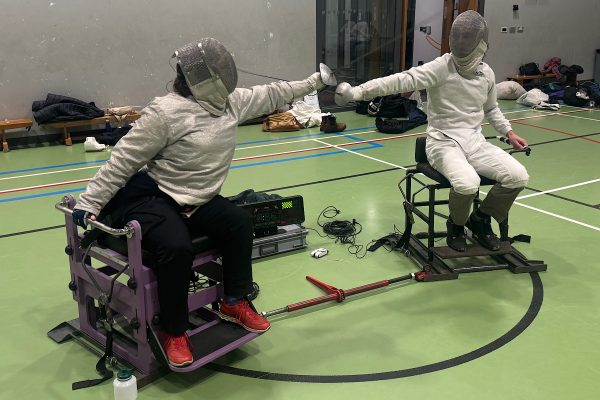
Fencing chair in action!

Satisfied client
- Skills involved:
- Issues Addressed:
- Activities Helped:
- Location:
- Solution: