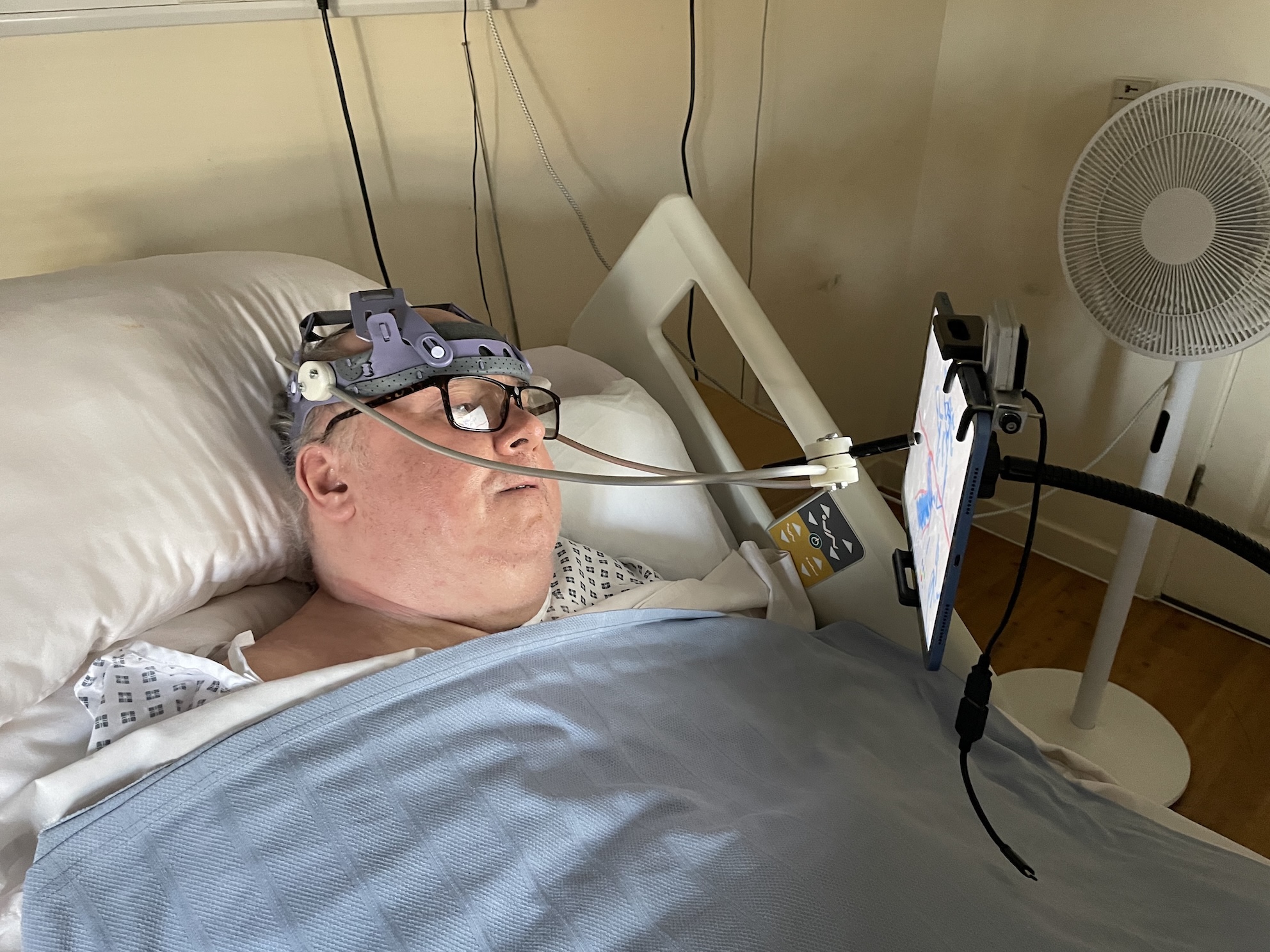
Digital Art head harness
The client is interested in painting but his spinal cord injury prevents him from participating. His OT and activity coordinator were seeking an alternative. However, he had an iPad and gooseneck stand that allowed it to be positioned in front of him. After consultation it was decided to try and create a device that he could control with his relatively limited movement to try digital painting.
The Challenge
Martin has a cervical spinal injury that resulted in him being quadriplegic. He only has control over his head and neck movement. He has an interest in painting and art but was unable to control the one option that he thought might be open to him, that of mouth painting.
After discussion he and his carers agreed that a good alternative might be digital painting using a tablet that he already owned. This has gained more popularity since it was publicised by David Hockney, among others. The challenge was to find a way of mounting a stylus in the correct location so he could see what he was painting, access the digital controls and have sufficient movement to reach all the tablet screen.
The solution
There were three parts to the design: a method of holding the digital stylus firmly to control the painting app; a device that positioned the stylus in the line of sight of the client; a harness that allowed the client to ‘wear’ the whole set up as head gear that was both controllable and comfortable.
The head harness was made from repurposed internals from a construction hard hat. Modern ones have a ratchet clamp that is designed to hold the hat firmly in position when working on site. The stylus was suspended from a 1m long length of curved aluminium tubing. The tubing was clamped in place and attached to the head harness with bolts through 3D printed clamps while a similar arrangement was made to clamp the stylus to the tubing.
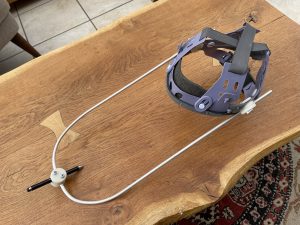 Head harness before fitting
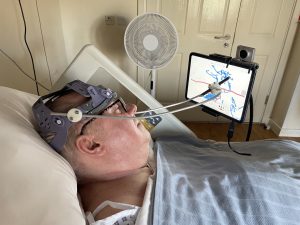 Harness in place and working after aluminium tubing was curved to the correct angle
The benefit
It’s clearly going to take a lot of practice and perseverance but the client now has the potential to create art with the minimum of intervention required by his carers. This gives him a level of independence that until now has seemed out of reach.
- Skills involved:
- Issues Addressed:
- Activities Helped:
- Location:
- Solution: