


Making arms weightless
The client has an unusually severe case of osteoporosis resulting in difficulties in lifting her hands to her mouth and being able to feed herself.
A frame of 25 mmx 2mm mild steel box section has been welded together and supports a counterweight system to unload the client’s arms. Counterweights are housed within the rolled hollow section that forms the frame; wires transmit their load, via pulleys, to the client’s wrists. Comfortable tubular bandage loops (with ‘tails’) slip around the wrists to transmit the loads. The client uses the tails on the wrist loops to pull the loops down when she wants to slip them onto her wrists; she prefers this to a system of quarter-turn locks to keep the counterweights in the upper location whilst she places her hands in the loops. The frame has not been painted as the client now relies on it so much that she does not want to let go of it. Similarly, the large wheels, lashed up at the rear of the frame to make frame movement easier on carpet, have not been finalised. The client finds that this device is fully effective in enabling her to eat and drink ‘normally’ at the table. The client also uses the frame for arm mobility exercises and finds that it enables her to write normally at the table again.
In response to questions about how arms were weighed and specifics were worked out, the following is offered:
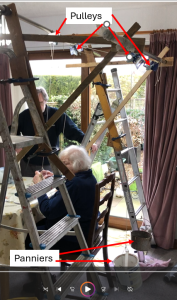
Two A-frames were made, using a couple of step ladders, supporting 2 tubes between each- see photographs.
To each tube , 2 pulleys were attached so that strings could be run over them; to each string, a hand was connected at one end and a pannier to the other. The pulleys don’t show well in the photos because they were bought from a shop, used with the labels on, and then returned when finished.
Panniers were weighted to find how much load the client needed applied to each string, to enable her to raise her hands.
The flexibility of the A-frame system was very useful as :
1/ it enabled us to find how far apart the strings needed to be – relative to the shoulder width,
2/ what angle of pull was required by the strings to the hands(Direction Cosines). A vertical pull was unhelpful; our client needed her hands pulled towards her mouth within controlled limits.
3/the distance from the back of the chair to the strings (Position Vector). On the final frame, a ‘stop’ was positioned to engage with the back of the client’s chair so that the position vector and Direction Cosines of the strings were always correct.
The Challenge
Lifting food and drink to her mouth at the table. Osteoporosis, causing complete disintegration of the shoulder joints prevents this.
Commercial solutions were investigated (very expensive ones!) and tested, but issues with arm hypermobility prohibited these.
The solution

 The client’s condition is progressively degenerative. The solution currently allows the client to eat and drink normally and unaided. She also uses the solution to facilitate mobility exercises and finds that she can now write at the table again.


The benefit
The client can now eat and drink normally and unaided at the dining room table . She can also write normally at the dining room table .
The client is now dependent on this device for her physical wellbeing.
- Skills involved:
- Issues Addressed:
- Activities Helped:
- Location:
- Solution:



Hia Brian… Looking at your great solution, I dont have welding facilities so Im making a similar out of wood. Just a couple of Q’s ..”what did you use as counterweights to fit inside the tube and did you guess the weight of the clients arms or did you find some way of weighing them to set the correct counter weight…?
Cheers Joe Lyman Leeds Branch
Hi Brian.
I want to thank you for posting this solution. It was instrumental to me persuading the OT to let me try a similar approach with my client – and her response was just as enthusiastic as your client’s.
I’ve just posted mine at https://remap.org.uk/solutions/making-arms-weightless-2/
Keep up the good work,
Steve