Bespoke Walking Stick handle
Ann has rheumatoid arthritis which has given her ulnar deviations of her fingers. This condition causes her fingers to bend towards the little finger and often results from swelling and weakening of the tendons and ligaments around the knuckles. Over time, everyday tasks such as gripping and grasping become more difficult.
The Challenge
Ann is unable to use either a normal or Fischer-handled walking stick comfortably or effectively due to her reduced grip and this was restricting her ability to go out and enjoy the fresh air. Ann’s physiotherapist, Heather, at York Hospital, suggested asking REMAP if they could produce a customised walking stick handle which she could grip and use with confidence.
The solution
REMAP volunteer, Gerry Van Hee, felt there was an opportunity to build on a Collaboration Initiative which was just starting between the University of Leeds and REMAP. As a first step he created an initial handle shape using a salt-dough model on a wooden former that was shaped with Ann to support her hand.
Gerry took that initial model to The University of Leeds and talked to Rhys Moore and James Watkins who are technical specialists in Additive Manufacturing / 3D Printing within the School of Mechanical Engineering. Rhys and James were very pleased to help with the project and use their design skills to bring the idea to live. Having scanned the initial mould, they created the first solid plastic prototype handle and fitted it to an adapted standard walking stick.
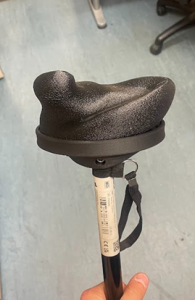
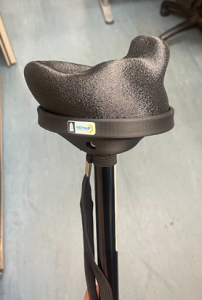
A number of iterations followed, working with Ann and Heather to refine the shape and fit of the handle. In the initial versions, Ann’s wrist was not sufficiently supported, so the design was changed to improve that, provide better control, and reduce wrist fatigue. The handle was shaped to provide a comfortable support with a snug fit, including special surface recesses to prevent pressure points around the knuckles and to provide better grip. Ann tried out each iteration and gave useful feedback on how comfortable and effective each version was.
Once the shape was stabilised, James focused on adjusting the technical design to provide the right level of tactile feel and to improve the feeling of grip. The final result was fully tested by Ann and she was very happy with the level of support the stick gave and how comfortable it was.
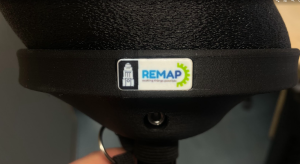
For the more technically minded – from Rhys and James: The project evolved from using rigid plastic to experimenting with TPU, which is a flexible 3D printing filament that better conforms to the shape of Ann’s hand. The base which connects the handle to the stick is made from PETG-CF (Carbon Fiber infused Polyethylene Terephthalate Glycol). This has a good balance between strength, comfort, and durability for everyday use. There is also a Polyjet printed logo set in the side of the handle to show the collaboration between REMAP and the University of Leeds. A variety of software was used, including Autodesk Meshmixer & Blender (for surface modelling) and SolidWorks for designing the base.
The benefit
Ann now has a comfortable walking stick that is fit for purpose. She is now able to walk with much more confidence using her adapted stick. The handle is very comfortable and provides effective support to her hand and wrist, whilst its good tactile feel makes it easier to grip and hold.
The development of this highly customised solution has shown the benefits an institution such as The University of Leeds can bring with its engineering skills and resources to make meaningful positive change to people’s lives.
- Skills involved:
- Issues Addressed:
- Activities Helped:
- Location:
- Solution: