


Custom Rollator/Walker for client with limited upper limb function
REMAP were approached to to see if we could help a gentleman born with arthogyrposis multiplex conginta – function deformity of both upper limbs – and with contractures and underdeveloped arms reducing functional use. In the last year he had also suffered reduced sensation in the feet – creating increased fall risk.
The NHS physio team thought he would benefit from assessment to see if a custom walking aid or rollator could be made to increase his stability. Due to upper limb differences, he was unable to use conventional aids.
The Challenge
Gerry requires the assistance of a walker as he is unable to walk far without pain and tiring. However both arms are under developed, and have limited movement. Hand function on the left is none existent and very limited movement or strength on the right. In addition his right arm is ‘locked’ across his chest.
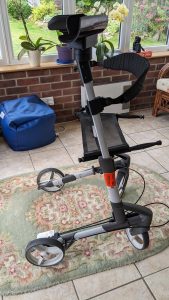
It was agreed at the first assessment visit that it may be possible to adapt a standard walker with forearm supports. To this end the NHS provided a Topro Troja Walker2 as shown.
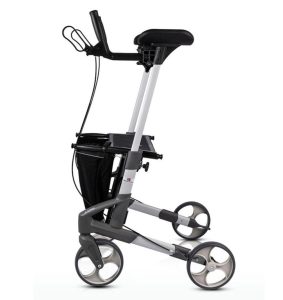
On the second visit with the Gerry and the machine the following was noted:
• He could place his left arm in the forearm support.
• The right hand forearm support would need to rotate inwards between 45 and 60 degrees; that should enable him to put is right arm in the support.
• The right arm support should be narrower and deeper than the existing ones; the client’s forearm is underdeveloped.
• The handles and brake levers are of no use to him; he cannot grip the handles or operate the levers.
• A foot operate brake system was discussed. The client demonstrated that he would be able to operate some sort of pedal near the rear wheel brakes with his right foot. Ideally, that would operate both brakes.
• For him to use the seat the right hand support would have to swivel back to straight. It was noted that he would be unable to operate a locking mechanism, so initially it was suggested that this would be a friction or spring detent system.
• Both NHS Physiotherapist and his carer agreed that he wouldn’t be going out alone even with the walker. This helps mitigate any issues with him not being able to operate the brakes as efficiently as he might.
The solution
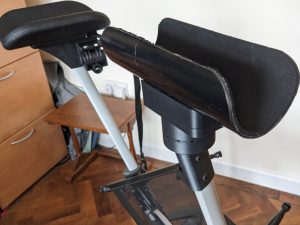
The existing RH arm support was removed completely and a new one manufactured from 3D printed parts and a reformed section of PVC gutter, lined with foam. The size and diameter of the support is a close fit to the clients forearm to provide the grip he otherwise lacks. At the first trial the support could be rotated through 90° and locked in four positions with a spring loaded detent. After the trial it was agreed that the support could be fixed in one position. The support was modified to clear the client’s elbow.
The brake system was modified by removing the handles and levers (as previously noted he could not operate them) and the existing brake cables taken to a custom designed and 3D printed foot-operated lever on the RH side. This has a mechanical friction lock. When pressed down it locks and holds the two brake pads on. When pushed back up it releases the brakes. The brake tension can be adjusted via the cables as per the original.
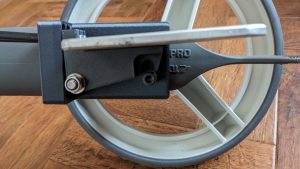
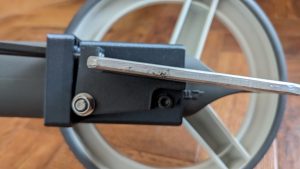
It was also noted that a back support strap would be beneficial. This particular rollator was not supplied with one, so a suitable support was procured. Simple adapters were made to allow the strap to be fitted and adjusted for the best position.
The benefit
Gerry will be able to get out of the house and walk and socialise.
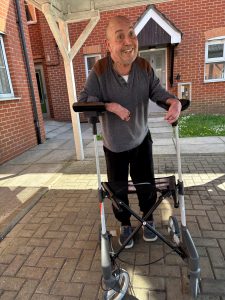
The completed project was delivered to Gerry on 5th June ’25 and he was very happy with the result and was looking forward to getting out and about with it. The image shows the client at the first trial before the back strap was added.
- Skills involved:
- Issues Addressed:
- Activities Helped:
- Location:
- Solution:



I’m happy to try and help – although there aren’t really any ‘tips’ as each case is unique. I can’t leave a direct contact email through this channel so I suggest follow the link to the Southampton and West Hants panel above and email me through that link.
I have a similar client. She has limited use of one arm, the other locked to her side. She typically uses a standard four-wheel walker backwards, wobbling the walker back and forth in the direction she walks. She also has limited vision and diminished cognitive function. Ideally, I would love to make something similar to this for her. I own and use a laser cutter and 3D printer. Would you be willing to send me any tips?