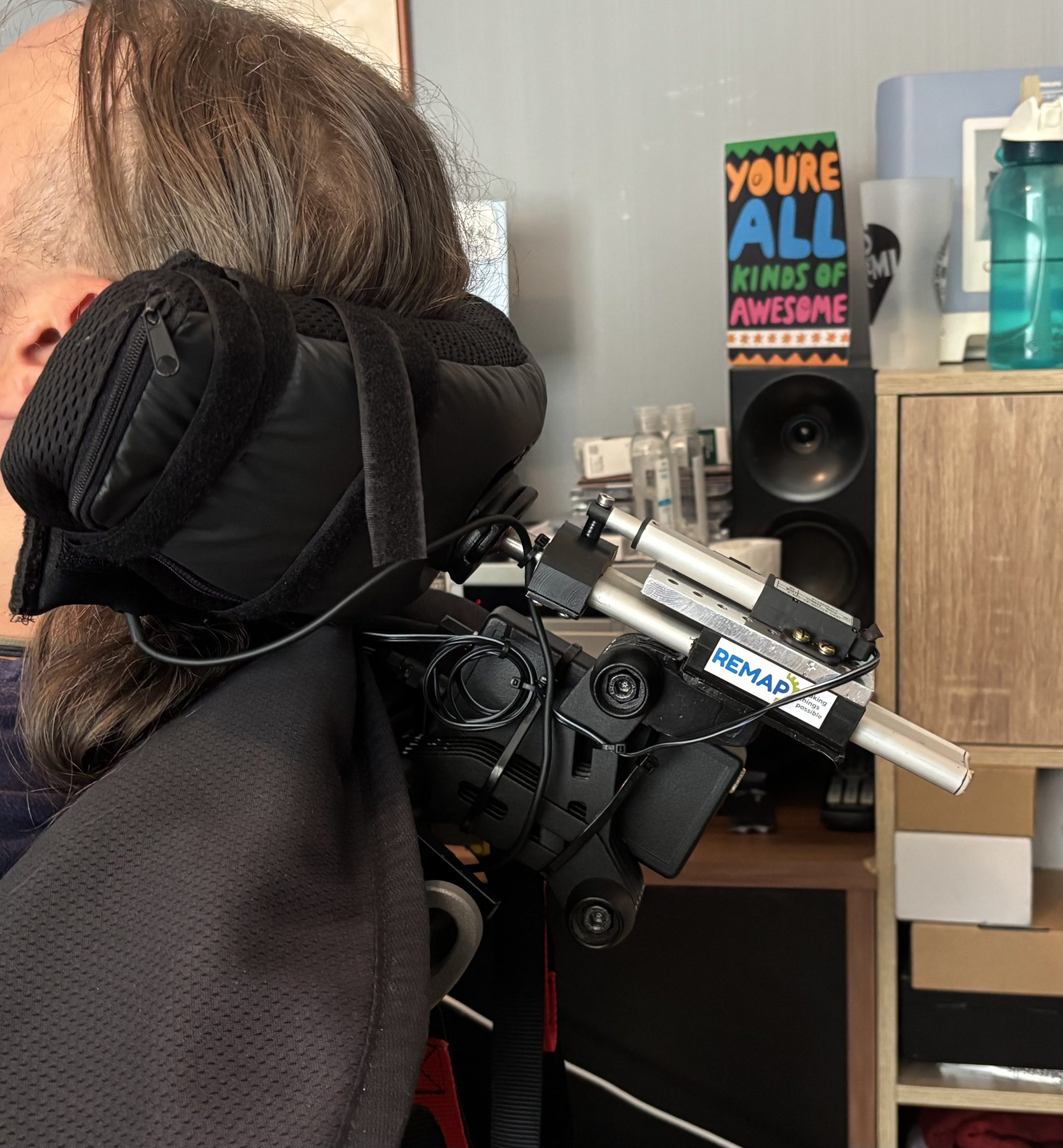
Motorised Headrest for power chair
A motorised headrest allows a power chair user to change head position forward or backward to reduce pain during some daily activities, including eating.
The Challenge
The client uses a Karma Evo Altus power chair for daily living. Pain means that he tends to be slightly reclined most of the time. In that position he is unable to lift his head forward for drinking, eating, or reading without pain. Therefore a means of allowing him to push and support his head in a more forward position was requested. A linear movement of 50mm from front to back would be sufficient. Being able to set the travel to anywhere in that range would be an advantage.
The system had to be powered independently of the chair to retain the warranty of the chair. The controls had to be easy-to-press buttons and placed where the client could operate them easily. Compatibility of the press buttons with a Origin Inc sip/puff interface was desirable for the future.
No commercially-available motorised headrest systems could be found.
Safety requirements included: inherent limiting of the adjustment range, safe charging and discharging of the chosen batteries (LiPo), and quick-release in the event of a failure in the actuator motor.
The solution
The existing Karma multi-adjustable headrest assembly included a ball joint arrangement where the headrest was connected to the mounting arm system. The solution involved fabricating a means of interposing in this a sliding arm mechanism under electrical control.
Volunteers Michael Garnish (mechanical aspects) and Clive Cassey (electronics/control) collaborated to achieve the result.
The project design was greatly eased by the very kind loan of an ex-demo headrest assembly of the same design by the UK distributor of Karma wheel chairs Lightweight Mobility & Seating Ltd ( https://www.lightweightmobilityandseating.co.uk/ ).
A new low-cost 12V-operated linear actuator of exactly 50mm stroke was sourced from Ebay. This includes internal limit switches which cut power when each limit of travel is reached. It was found to operate down to about 5V, and so can be powered from a two-cell LiPo battery pack which gives 8.4V maximum.
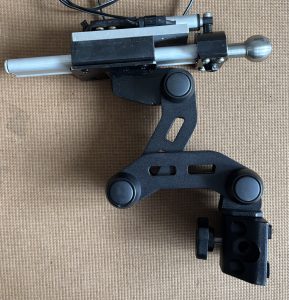
A sliding arm assembly was salvaged from a scrap wheelchair. A metal plate was fabricated to mount the actuator on the top face, and a bottom adapter plate was welded to include a four-fingered “comb” to attach to the five-fingered equivalent joint at the top of the arm. A new ball joint was turned and attached to the end of the sliding arm. The actuating arm was attached to operate the sliding arm using a machined nylon block.
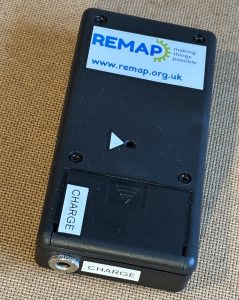
A standard Hammond plastic enclosure from RS Components was assembled to include an Adafruit Inc motor control board and the two-cell LiPo battery, together with its charging regulator board (from AliExpress) and charge/discharge balancing safety board from Ebay. The attached Design File shows the system diagram.
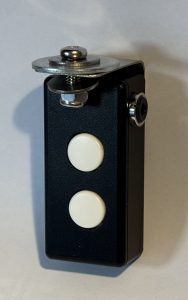
A small standard enclosure was used to mount two low-force keyboard pushbuttons for the client to select forward or backward motion. If both buttons are accidentally pressed, the motor controller does not power the motor.
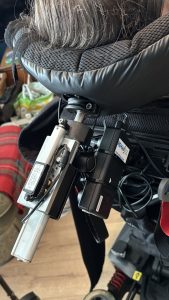
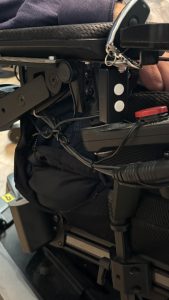
The system diagram for the battery pack is linked here: B56-008_Head_Support_Diagrams-Schematic-LiPo
The parts list is linked here: parts_list_table
To allow the headrest to be moved out of the way in the event of a failure of the actuator, the M8 fastener in the lower arm pivot point was replaced with an adjustable clamp bolt, which has a quick-release handle.
The benefit
The client is now able to electronically adjust the position of his head – forward or backward – to minimise pain while carrying out whichever activity he needs to, such as eating or using screens.
- Skills involved:
- Issues Addressed:
- Activities Helped:
- Location:
- Solution: